
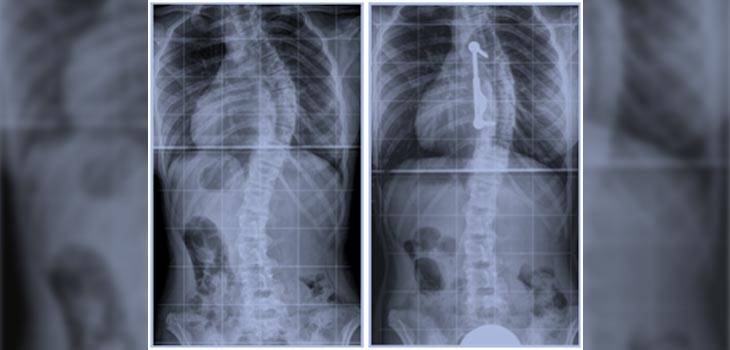
In what may turn out to be good news for adolescent sufferers from scoliosis, Israeli company ApiFix Ltd. reports “substantial reduction’ in the curvature in spines in a new study looking at a non-fusion, minimally invasive approach to scoliosis correction. The interim results reported patient outcomes for 25 patients at the one to three year follow-up point.
MIS Scoliosis Gets Boost from New Study
1 min read Premium comments
Secondary
“Scoliosis surgery is the most invasive procedure in spine. Now, there is a minimally invasive alternative for many of these children and adolescents, ” said Yizhar Floman, M.D., director of the Israel Spine Center at Assuta Hospital, Tel Aviv, and past president of the Israel Spine Society.
According to the company’s press release, the ApiFix system has been used in 50 adolescents since it was approved for marketing in Europe. Floman, principal investigator for the ApiFix® clinical study, reports that. “patients are pain-free and happy with their new back shape. No implant failure has been observed.”
A report of a clinical study of The ApiFix System, led by Floma, was published this year in the peer-reviewed medical journal Scoliosis. He concluded that, “there are many drawbacks to the current gold standard of adolescent idiopathic scoliosis (AIS) surgery, which are almost nonexistent with the use of ApiFix.” He listed the drawbacks as being, “considerable blood loss leading to blood transfusions, neurologic deficit including spinal cord lesions, late infections, pseudoarthrosis, limitation of spinal motion also affecting non-fused levels, back pain and disc degeneration in the non-fused spinal segments.” He wrote: “Almost all of these complications can be avoided by the use of ApiFix.”
Author
React:
Discussion
This is a fascinating development. In my practice we've seen similar outcomes with the revised protocol. The key differentiator seems to be patient selection criteria. Has anyone else noticed the correlation with BMI thresholds?
Great point. I'd push back slightly on the conclusion, the sample size in the cited study is too small to draw population-level inferences. That said, the directional signal is compelling and worth a larger RCT.
We implemented a similar approach last year. Early results are promising but we're still gathering 12-month follow-up data. Happy to share our protocol if anyone is interested.
Join the conversation
Orthopedic professionals are discussing this. Sign in and upgrade to read every comment and add your voice.