
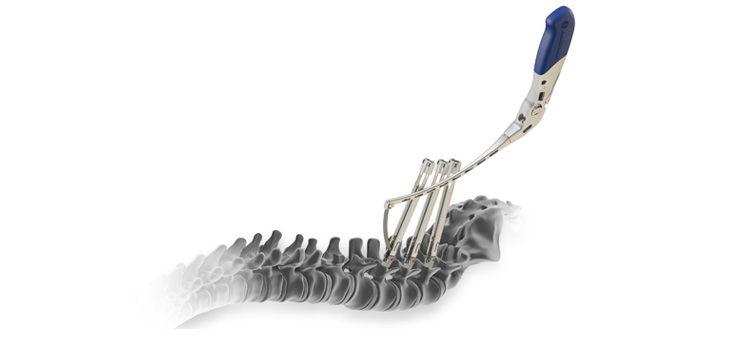
Medtronic plc used the recent IMAST meeting (International Meeting on Advance Spine Techniques) in Kuala Lumpur, Malaysia, to launch its CD Horizon Solera Voyager Spinal System for Minimally Invasive Spine procedures.
Medtronic Expands TLIF Procedure and Buys RF Surgical
1 min read Premium comments
Secondary
Multiple Rod Insertion Options
According to a July 8, 2015 company announcement, the Solera Voyager “expands upon the transforaminal lumbar interbody fusion (TLIF) procedure by offering multiple, minimally invasive rod insertion options and enabling a seamless 3D-navigated surgical experience.”
Percutaneous or Wiltse Approach
The system features low profile, extended tabs screw with inner threading. The company says the features “ease rod insertion and facilitates rod reduction” and gives surgeons the flexibility to use either a percutaneous or Wiltse minimally invasive approach for rod insertion.
The system is part of the company’s Surgical Synergy platform, an integrated portfolio of navigated surgical technologies.
Doug King, president of Medtronic’s spine business and senior vice president of Medtronic, said the Solera Voyager represents the company’s “commitment to take minimally invasive techniques and 3D navigated surgery even further and develop solutions with clinical and economic value.”
Agreement to Acquire RF Surgical
In an unrelated July 13, 2015 announcement, the company said it signed a definitive letter of agreement to acquire RF Surgical Systems, Inc. RF Surgical focuses on the detection and prevention of retained surgical items (sponge, gauze or towel) for approximately $235 million. The system is used as an adjunct to manual counting methods and uses a low radio frequency signal to track the surgical items.
Author
React:
Discussion
This is a fascinating development. In my practice we've seen similar outcomes with the revised protocol. The key differentiator seems to be patient selection criteria. Has anyone else noticed the correlation with BMI thresholds?
Great point. I'd push back slightly on the conclusion, the sample size in the cited study is too small to draw population-level inferences. That said, the directional signal is compelling and worth a larger RCT.
We implemented a similar approach last year. Early results are promising but we're still gathering 12-month follow-up data. Happy to share our protocol if anyone is interested.
Join the conversation
Orthopedic professionals are discussing this. Sign in and upgrade to read every comment and add your voice.