
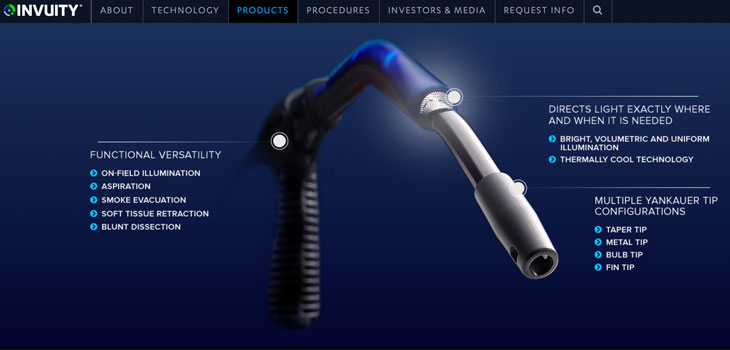
Patients appreciate this kind of technology…Invuity, Inc. has been recognized by The Joint Commission for its proprietary technology that helps prevents unintended retained foreign objects (URFOs) that are left inside patients during surgery.
Joint Commission Recognizes Invuity Technology
1 min read Premium comments
Secondary
“Surgeons can reduce the likelihood of URFOs by utilizing superior illumination technology to thoroughly inspect the surgical cavity, ” said Philip Sawyer, president and CEO of Invuity, in the July 21, 2015. “The Joint Commission’s acknowledgement of the importance of our proprietary technology in improving patient safety puts Invuity another step closer to becoming the standard of care in surgical procedures.”
Sawyer told OTW, “Invuity is proud to be recognized by The Joint Commission. It’s a testament to the value our technology brings to healthcare organizations, especially as they adjust to meet the rapid demand for minimal access and minimally invasive surgery. Our devices enable surgeons to see more than they ever have before during these complex procedures, helping to ensure that ‘never events, ’ such as URFOs, truly never occur. In years to come, we are committed to continuously advancing our technology as the standard of care, and partnering with healthcare organizations to attain the highest patient safety standards.”
React:
Discussion
This is a fascinating development. In my practice we've seen similar outcomes with the revised protocol. The key differentiator seems to be patient selection criteria. Has anyone else noticed the correlation with BMI thresholds?
Great point. I'd push back slightly on the conclusion, the sample size in the cited study is too small to draw population-level inferences. That said, the directional signal is compelling and worth a larger RCT.
We implemented a similar approach last year. Early results are promising but we're still gathering 12-month follow-up data. Happy to share our protocol if anyone is interested.
Join the conversation
Orthopedic professionals are discussing this. Sign in and upgrade to read every comment and add your voice.