
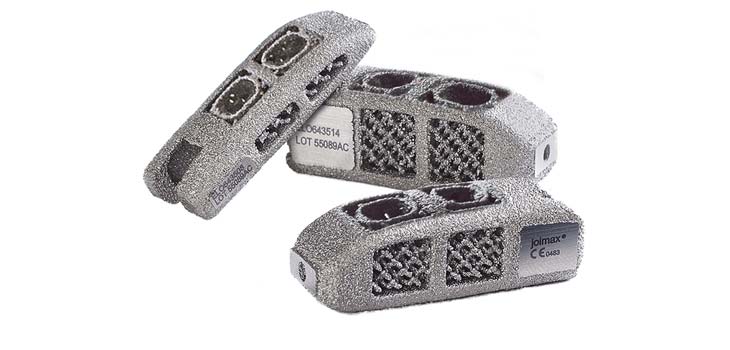
German-based minimally invasive endoscopic spine surgery technology developer joimax GmbH has been cleared by the FDA to market the company’s Endoscopic Lumbar Interbody Fusion, or EndoLIF On-Cage: 3D-printed implant.
FDA Clears joimax’s Endoscopic-Assisted Fusion Cage
2 min read Premium comments
Secondary
Enabling Fusion
In a July 13, 2015 press release, the company stated the new implant allows surgeons to use an inter-muscular approach, “similar to a mini transforaminal lumbar interbody fusion (TLIF), into the intervertebral disc, enabling endoscopic-assisted fusion.”
EndoLIF Implant
The implant consists of titanium alloy, produced with Electron Beam Melt (EBM) technology. The cage has a porous surface with diamond cell structure, providing an “optimal base for cell proliferation and bone growth.” Two large openings can be filled with autogenous bone to support the creation of a straight column for fusion.
The cage is designed to be used with supplemental posterior fixation, such as the joimax Percusys percutaneous pedicle screw-rod system. According to the company, cage implantation can be performed with a posterior or postero-lateral approach, either using an open or endoscopic-assisted method.
Surgical Site Access
Access to the surgical site is one the main challenges when using endoscopic surgical methods.
Two German spine specialists, Ralf Wagner, M.D. of the LIGAMENTA Spine Center in Frankfurt and Bernd Illerhaus, M.D., at Datteln/Recklinghausen, have performed more than 200 out of 600 EndoLIF procedures in Europe, according to the company. “The access is dura and nerve-gentle, preserves the dorsal bony structures and we can avoid scar tissue because of the stepwise tissue dilation, ” said Dr. Illerhaus.
Yeung: “Elevate Interest”
Anthony Yeung, M.D., one of the most well-known proponents and teachers of endoscopic spine procedures, has made no secret of his caution of fusing the spine. But Dr. Yeung told OTW that he congratulates joimax for this implant, which he says “will elevate the interest in transforaminal endoscopic surgery, including stabilization as part of a least invasive and most effective technique.”
“This is another iteration of the transforaminal endoscopic approach to augment the least invasive T-Lif approaches already on the market, specifically iO-Lif implants by Amendia, Globus, and others. There are differences in cage structure and design offered by different companies. It comes with the desirable knowledge and training for transforaminalplasty, a partial decompression of the lateral facet to make room for cage implantation without sacrificing the whole facet and destabilizing the spine, thus necessitating posterior stabilization. The transforaminal fusion approach will continue to evolve using smaller expandable cages with larger footprints that will create enough anterior stability to eliminate the need for posterior instrumentation.”
Ultimately, he says a significant number of fusions can be decreased by “endoscopic decompression, ablation, dynamic stabilization and even nucleus augmentation before fusion.”
However, he adds that there are pitfalls and complication risks to the transforaminal approach consisting of anatomic nerve variations and patho-anatomy that increase complication risk, “but can be overcome with proper training.”
More Gentle Techniques to Follow
“With the EndoLIF program, joimax offers a complete endoscopic-assisted solution for spinal stabilization and fusion. In the future, we will be able to treat patients with even more gentle techniques, ” said Wolfgang Ries, CEO and founder of joimax. “Our next development will be an EndoLIF Cage on the basis of our iLESSYS Delta system for posterior lumbar inter-body fusion (PLIF).”
Author
React:
Discussion
This is a fascinating development. In my practice we've seen similar outcomes with the revised protocol. The key differentiator seems to be patient selection criteria. Has anyone else noticed the correlation with BMI thresholds?
Great point. I'd push back slightly on the conclusion, the sample size in the cited study is too small to draw population-level inferences. That said, the directional signal is compelling and worth a larger RCT.
We implemented a similar approach last year. Early results are promising but we're still gathering 12-month follow-up data. Happy to share our protocol if anyone is interested.
Join the conversation
Orthopedic professionals are discussing this. Sign in and upgrade to read every comment and add your voice.