
Researchers from Purdue University are making it possible to deliver drugs using wirelessly controlled nanowires. The nanowires, made of a polymer that responds to electromagnetic fields, can be loaded with a drug. Then, when the correct electromagnetic field is applied, the nanowires release small amounts of the drug.
Deliver Drugs Remotely Via Nanowires!
2 min read Premium comments
Secondary
“This tool allows us to apply drugs as needed directly to the site of injury, which could have broad medical applications, ” Dr. Borgens, director of the Center for Paralysis Research at Purdue, said in the June 23, 2015 news release. “The technology is in the early stages of testing, but it is our hope that this could one day be used to deliver drugs directly to spinal cord injuries, ulcerations, deep bone injuries or tumors, and avoid the terrible side effects of systemic treatment with steroids or chemotherapy.”
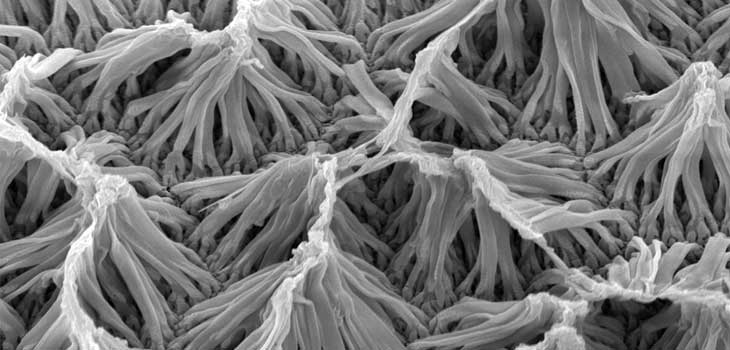
The news release states, “Wen Gao, a postdoctoral researcher in the Center for Paralysis Research who worked on the project with Borgens, grew the nanowires vertically over a thin gold base, like tiny fibers making up a piece of shag carpet hundreds of times smaller than a human cell…The researchers captured and transported a patch of the nanowire carpet on water droplets that were used to deliver it to the site of injury. The nanowire patches adhere to the site of injury through surface tension.”
“We think it is a combination of charge effects and the shape change of the polymer that allows it to store and release drugs, ” he said. “It is a reversible process. Once the electromagnetic field is removed, the polymer snaps back to the initial architecture and retains the remaining drug molecules.”
Polypyrrole is an inert and biocompatable material, but the team is working to create a biodegradeable form that would dissolve after the treatment period ended, he said.
Dr. Borgens told OTW, “My most memorable moment was learning we could actually release the drug from the nano-material at ‘long distance’ and by remote control. Not only that, but on Dr. Gao’s first try, she was able to deliver Dexamethasone for over two weeks continuously 24/7.”
Asked about how they are creating the biodegradable form, Dr. Borgens noted, “There are already biodegradable forms available, but they do not exactly meet our needs yet. In terms of biodegradability we don’t have to discover anything, we need to improve upon recipes by others, it is really not necessary to make a biodegradable form. The polymer is totally inert and the size of the implant is so small you can barely see it with a microscope. Putting such an implant in a person would be like pouring a bucket of dye into the ocean.”
“This technology has real promise for the orthopedic surgeon. Of particular interest would be infection or other problems that do not respond well to IV treatments because the side effects are so profoundly bad. An example would be deep decubitus unresponsive ulcers and infections. They need be healed from the inside out and this is something that we can now offer in the complete absence of side effects.”
Author
React:
Discussion
This is a fascinating development. In my practice we've seen similar outcomes with the revised protocol. The key differentiator seems to be patient selection criteria. Has anyone else noticed the correlation with BMI thresholds?
Great point. I'd push back slightly on the conclusion, the sample size in the cited study is too small to draw population-level inferences. That said, the directional signal is compelling and worth a larger RCT.
We implemented a similar approach last year. Early results are promising but we're still gathering 12-month follow-up data. Happy to share our protocol if anyone is interested.
Join the conversation
Orthopedic professionals are discussing this. Sign in and upgrade to read every comment and add your voice.