
Knoxville, Tennessee based, privately held, ChoiceSpine, LP launched its Blackbird Posterior Cervical System for commercial markets on July 13, 2015. The system was cleared by the FDA in June 2014.
ChoiceSpine Launches Posterior Cervical System
1 min read Premium comments
Secondary
Company Vice President of Research and Development Steve Ainsworth, Ph.D., said the system has had over 150 successful surgeries. Director of Business Development Anderson Collins said this system, and other products in the company’s product pipeline, “will continue to fuel the double digit growth” the company has experienced over the last couple of years.
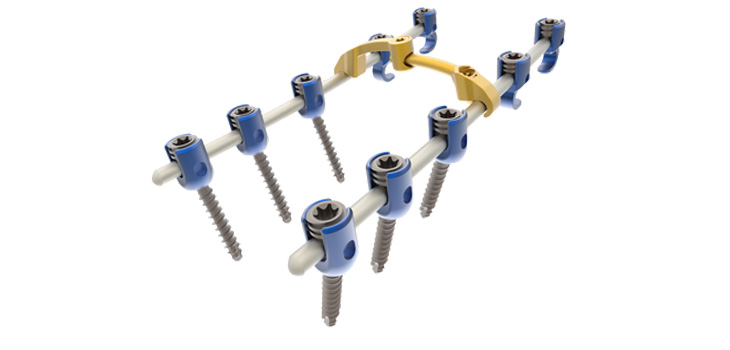
A company announcement stated the Blackbird is a “comprehensive system for posterior fixation of the cervical and upper thoracic spine, ” and offers a number of screws, hooks, & rods. The Blackbird is the first of three commercial products the company plans to launch in 2015.
Features
The system, according to the company, features:
- Polyaxial head that offers non-biased 70°of conical angulation
- Fully threaded and smooth shank screws in multiple diameters
- Dovetail set screw that minimizes head splaying and cross-threading
- Variety of connectors allows for diverse variation in anatomy and surgical technique
ChoiceSpine
ChoiceSpine acquired Baxano Surgical Inc.’s Veo Lateral Access & Interbody Fusion System in early February 2015. Ainsworth was TranS1’s third employee and served as the company’s vice president of research and development throughout Baxano’s acquisition of TranS1.
Rick Henson and Marty Altshuler started the company in December 2006 in Knoxville and acquired Orthotec, then a $40 million dollar company. Orthotec is the company Alphatec, Inc. agreed to pay $49 million to settle a lawsuit filed by Orthotec alleging fraudulent transfers of assets of a company that Alphatec had previously acquired.
Author
React:
Discussion
This is a fascinating development. In my practice we've seen similar outcomes with the revised protocol. The key differentiator seems to be patient selection criteria. Has anyone else noticed the correlation with BMI thresholds?
Great point. I'd push back slightly on the conclusion, the sample size in the cited study is too small to draw population-level inferences. That said, the directional signal is compelling and worth a larger RCT.
We implemented a similar approach last year. Early results are promising but we're still gathering 12-month follow-up data. Happy to share our protocol if anyone is interested.
Join the conversation
Orthopedic professionals are discussing this. Sign in and upgrade to read every comment and add your voice.