
According to a new study that took place at the Kerlan Jobe Orthopedic Clinic, patients who utilize a web-based tutorial will understand their knee surgery better…and they will have a better experience overall.
Web Learning Increases Patient Understanding of Knee Surgery
2 min read Premium comments
Secondary
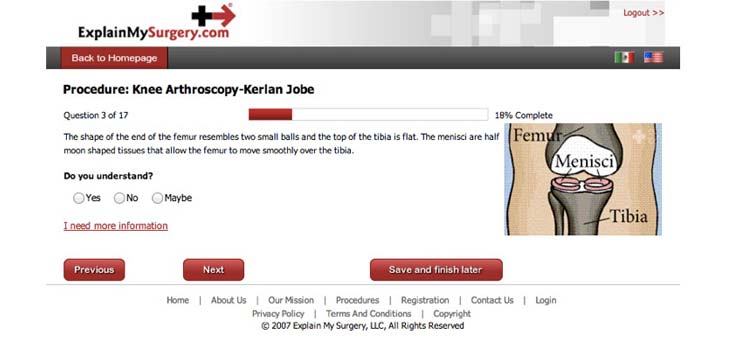
The study, just published in The Journal of Bone and Joint Surgery (JBJS), involved a control group “(29 patients) and an intervention group (26 patients), all of whom were similar in terms of age and level of education.” The former “received standard preoperative counseling; [the latter] group had a 20-minute web-based multimedia tutorial in addition to the preoperative counseling.”
“The goal of our study was to evaluate the effect of a multimedia patient education tool on the surgical experience of patients undergoing first-time knee arthroscopy, ” said lead author and orthopedic sports surgeon Bob Yin, M.D., in the June 19, 2015 news release. “We found that when used as an adjunct to the traditional patient-surgeon interaction, the web-based tutorial was an effective tool for enhancing the patient’s perioperative experience.”
As indicated in the news release, “Preoperatively, when compared with the control group, the intervention group felt significantly more informed about and prepared for the surgery and understood the risks, benefits, and alternatives of the surgery. On the day of the surgery, the intervention group patients continued to feel more informed about the surgery than the control group and were more satisfied with the preoperative information and tutorial that they had received. There were no significant differences between groups in terms of preparedness; anxiety; or understanding of the risks, benefits, and alternatives. Postoperatively, knowledge assessment showed that patients who had completed the web-based tutorial were significantly more likely to correctly identify which meniscus had been operated on. They were also more likely to know whether a chondroplasty, a surgical procedure that reshapes damaged cartilage, had been performed.”
Dr. Yin told OTW, “One interesting and somewhat surprising finding of our study was how quickly patients forgot the surgical findings that were explained to them at the post-operative visit. A significant number of patients in this study did not recall the operative findings or the specific procedures performed just a few weeks after surgery. This allows us to better understand why so many patients who have had knee arthroscopy a year to two ago do not remember details about their surgery. As our results showed, the web module enhanced short term recall of the patients’ surgical details when used as an adjunct to traditional peri-operative counseling.”
“The feedback from patients, both solicited and unsolicited, has been overwhelmingly positive among those who completed this web-based teaching module. During her post-operative visit, one patient asked for access to the module for a friend who was having the same surgery done.”
React:
Discussion
This is a fascinating development. In my practice we've seen similar outcomes with the revised protocol. The key differentiator seems to be patient selection criteria. Has anyone else noticed the correlation with BMI thresholds?
Great point. I'd push back slightly on the conclusion, the sample size in the cited study is too small to draw population-level inferences. That said, the directional signal is compelling and worth a larger RCT.
We implemented a similar approach last year. Early results are promising but we're still gathering 12-month follow-up data. Happy to share our protocol if anyone is interested.
Join the conversation
Orthopedic professionals are discussing this. Sign in and upgrade to read every comment and add your voice.