
In 2009 we wrote about Afghan orthopedic surgeon Lt. Colonel Mohammad Wardak, M.D.’s invention of the Afghan external fixation device for the knee. Dr. Wardak had to develop the device surreptitiously while the Taliban was in power. His bravery in pursuing innovation under dangerous cultural conditions was inspiring.
Wardak’s Afghan Device Study Published
2 min read Premium comments
Secondary
Published Results
Results of the effectiveness of the device have now been published in the June 15, 2015 issue of MOJ Orthop Reumatol (Treatment of Patella Fractures by Compressive External Fixation (CEF). MOJ Orthop Rheumatol 2(6): 00070. DOI: 10.15406/mojor.2015.02.00070).
According to the study, Dr. Wardak’s compressive external fixation (CEF) device offers “absolute stability, provides a significant decrease in hospital stay [and] gives rapid bone healing and rehabilitation.” Study authors included Bari MM, Shahidul Islam, NH Shetu, Mahfuzer Rahman, Mashiur H. Munshi, Md. Golam Mostofa and Mohammad Islam Khan from the Bari-Ilizarov Orthopaedic Center and the National Institute of Traumatology and Orthopaedic Rehabilitation in Bangladesh.
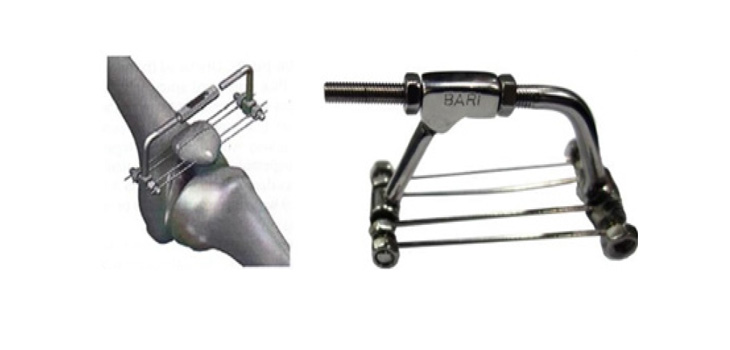
The device, based on the Ilizarov tensioned wire construct, consists of two 1.5mm wires passed horizontally through the proximal fragment. Two additional 1.5mm wires are placed in the distal fragment. The wires are passed through the related holes in the clamp assembly. The clamp assemblies are connected to one another. The wires are secured by the nuts on the clamp assembly. Tensioning of the wires and compression of the fractures are done by distracting the clamps from one another by turning the distraction nut until the tension wires are tight.
Study Conclusions
From January 2010 to January 2014, 18 patients with displaced fractures of the patella were treated with the Afghan device while 11 patients were treated percutaneously. Nine of the 18 cases had the treatments on closed transverse fractures of patella presenting less than three days from the time of injury. The remaining nine cases were performed through an open procedure. Open reduction was done in all open fractures, upper and lower pole fractures or when accurate reduction was not achieved percutaneously. All the surgeries were performed under spinal anesthesia.
According to the authors, sound union was achieved in all the fractures. The Afghan device was removed at six to eight weeks. Twelve patients regained “excellent motion with a mean Insall knee score of 96 points, in an average follow up of four years. Minor complications like wire inflammation was observed in five patients who were treated by local care and antibiotics.”
The authors concluded that the CEF technique is a “safe and effective method of treatment in patella fractures with advantages over traditional methods in case with a poor soft tissue envelope. CEF allows rapid recovery and no secondary surgery is needed.”
Dr. Wardak was and continues to be the Chief of Orthopedic Trauma at the National Military Hospital in Kabul, Afghanistan.
To view the study, click here.
Author
React:
Discussion
This is a fascinating development. In my practice we've seen similar outcomes with the revised protocol. The key differentiator seems to be patient selection criteria. Has anyone else noticed the correlation with BMI thresholds?
Great point. I'd push back slightly on the conclusion, the sample size in the cited study is too small to draw population-level inferences. That said, the directional signal is compelling and worth a larger RCT.
We implemented a similar approach last year. Early results are promising but we're still gathering 12-month follow-up data. Happy to share our protocol if anyone is interested.
Join the conversation
Orthopedic professionals are discussing this. Sign in and upgrade to read every comment and add your voice.