
Mainstay Medical International, a company listed on the Irish and Paris, France Stock Exchanges, has received approval from the United States Food and Drug Administration to begin a clinical trial of ReActive8 under an Investigational Device Exemption.
Trial Begins on Novel Spinal Neurostimulator
1 min read Premium comments
Secondary
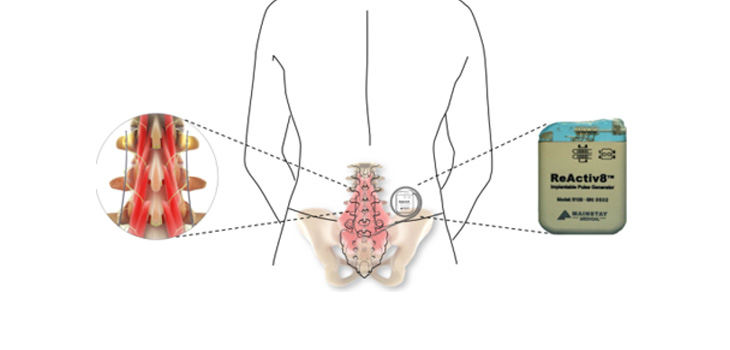
ReActiv8 is an implantable neurostimulation system designed to reduce the pain and disability experienced by suffers with chronic low back pain (CLBP). The device is claimed to restore control to the muscles that stabilize the lumbar spine.
The planned trial will be an international, multi-center, prospective randomized trial designed to evaluate the safety and efficacy of ReActive8 for the treatment of adults with CLBP. The approval allows for up to 40 clinical trial sites and for 128 randomized subjects to be implanted with ReActive8 in the pivotal cohort. Upon successful completion of the trial, and if the results support it, the company plans to submit an application for a Pre-Market Approval, a move which is required to start commercialization in the United States.
The chief investigator for the trial is Christopher Gilligan, M.D., Chief, Division of Pain Medicine at Beth Israel Deaconess Medical Center in Boston and Assistant Professor of Anesthesiology at Harvard Medical School. He also serves as head of the Data Monitoring Committee of the ReActiv8 Trial.
The FDA approval to start a US clinical trial of ReActiv8 is a major step toward out goal of bringing ReActiv8 to the US market, said Mainstay CEO Medical Peter Crosby. We are impressed with the FDA’s responsiveness during the development and review of the trial. It helped us to develop a clinical trial to meet the needs of the company, the FDA and the millions of people who could potentially benefit from ReActiv8.”
Author
React:
Discussion
This is a fascinating development. In my practice we've seen similar outcomes with the revised protocol. The key differentiator seems to be patient selection criteria. Has anyone else noticed the correlation with BMI thresholds?
Great point. I'd push back slightly on the conclusion, the sample size in the cited study is too small to draw population-level inferences. That said, the directional signal is compelling and worth a larger RCT.
We implemented a similar approach last year. Early results are promising but we're still gathering 12-month follow-up data. Happy to share our protocol if anyone is interested.
Join the conversation
Orthopedic professionals are discussing this. Sign in and upgrade to read every comment and add your voice.