
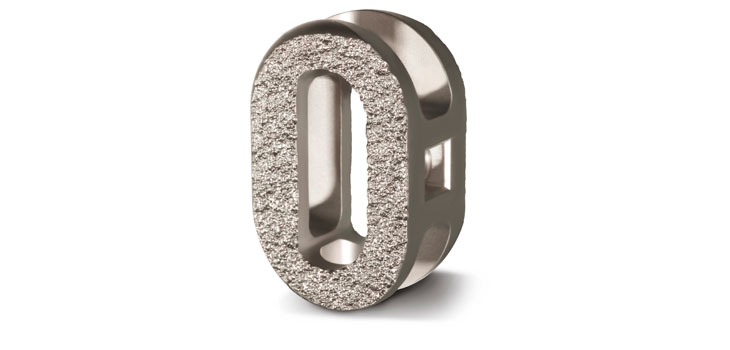
Titan Spine is touting the results of a new study demonstrating a reduced subsidence rate and overall subsidence amount of its Endoskeleton TA device compared to a commercially available PEEK device. The findings emanate from a dynamic mechanical study assessing subsidence rates of spinal implants during continuous cyclic loading.
Titan Spine: Endoskeleton Looking Good Compared to PEEK
2 min read Premium comments
Secondary
In this study, “Titan’s TA ALIF interbody device provided for a 410% reduction in rate of subsidence and a 40% reduction in overall subsidence amount compared to a commercially available ALIF PEEK implant of a similar footprint.” All of the company’s Endoskeleton devices feature Titan Spine’s proprietary technology, consisting of a unique combination of roughened topographies at the macro, micro, and cellular levels. As indicated on the company website, “This unique combination of surface topographies is designed to create an optimal host-bone response and actively participate in the fusion process by promoting the upregulation of osteogenic and angiogenic factors necessary for bone growth, encouraging natural production of bone morphogenetic proteins (BMPs), downregulating inflammatory factors, and creating the potential for a faster and more robust fusion.”
Antonio Valdevit, Ph.D., Professor, Department of Chemical Engineering & Materials Sciences at Stevens Institute of Technology, was lead author of the study. Dr. Valdevit told OTW, “Most investigations of this type deal with thousands or millions of cycles when dealing with implant/bone or isolated implant fatigue. In this particular case, we applied the techniques to the very early phase of implant/vertebra interactions. In the early phase following surgery, the interactions between implants and the host bone are very different as compared to the long-term effects.”
Asked about future research, Dr. Valdevit added, “The research community (in conjunction with clinicians) should arrive at a standardized or, at least, a consensus as to the optimal testing duration and anatomical model for future conduction of these tests that include an animal model so as to reduce the potential for large variations in human anatomical samples. Alternatively one may be able to parameterize anatomical specimen geometry and density with implant performance to arrive at some clinical predictability regarding the dynamic outcomes associated with use of a particular implant under patient-specific conditions. While such an undertaking will require a large number of samples and time, it may provide more relevant clinical data.”
“Implant behavioral effects, including subsidence, upon the underlying bone and biological interaction is a dynamic effect and is greatly influenced by both design and material. A study that examines the biological effects under mechanical loading would provide a more physiological and clinical perspective as to implant performance. Such an experiment would consider the dynamic mechanical response in addition to the biological effects of the implant design and material. Conceptually, it would require a bioreactor type of chamber under mechanical loading combined with a stable cellular culture system.”
“Subsidence is a dynamic and continuous event and should be evaluated as such. Current standards employ a single compressive force to determine subsidence into a foam representative of bone. Implant performance is a consequence of both design and material which cannot be properly evaluated under a static condition when in reality the environment is dynamic both mechanically and biologically.”
Author
React:
Discussion
This is a fascinating development. In my practice we've seen similar outcomes with the revised protocol. The key differentiator seems to be patient selection criteria. Has anyone else noticed the correlation with BMI thresholds?
Great point. I'd push back slightly on the conclusion, the sample size in the cited study is too small to draw population-level inferences. That said, the directional signal is compelling and worth a larger RCT.
We implemented a similar approach last year. Early results are promising but we're still gathering 12-month follow-up data. Happy to share our protocol if anyone is interested.
Join the conversation
Orthopedic professionals are discussing this. Sign in and upgrade to read every comment and add your voice.