
Nepal: American Orthopedic Surgeons Leap Into the Fray
The Awful Nepal Disaster: Orthopedists to the Rescue, Again // Thomas Einhorn, M.D. New Head of Clinical and Transitional Research at NYU Langone
6 min read Premium comments
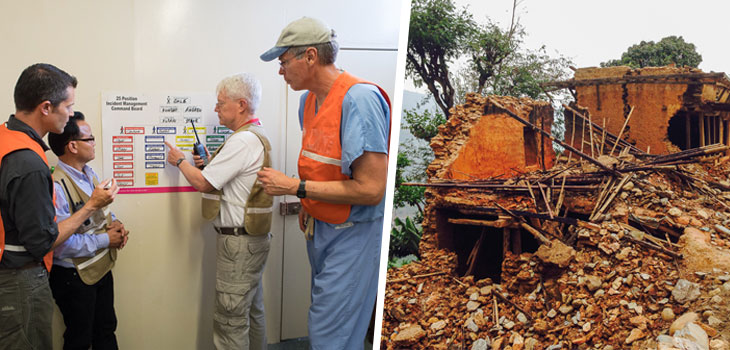
The disaster is horrible, and ongoing. There is at least one glimmer of positivity, however. The U.S. orthopedic surgeons can’t say enough good things about their Nepali orthopedic colleagues. Scott C. Nelson, M.D., a pediatric orthopedic surgeon at Loma Linda University (LLU) in California, went to a hospital near Kathmandu at the request of Scheer Memorial Hospital, an LLU affiliate within the Adventist worldwide healthcare system. He told OTW, “We saw a variety of orthopaedic injuries including spine fractures, hip and pelvic fractures as well as a variety of upper and lower extremity injuries. Hospitals were crowded with patients filling the hallways and corridors of the buildings. Most everyone was suffering from orthopaedic injuries; many who had jumped out of buildings.”
“I spent most of the week operating on spine fractures as well as pelvis, acetabulum and hip fractures. We arrived 12 days after the earthquake and most of the life threatening injuries and orthopaedic emergencies had been addressed, whereas some of the more complex resource intensive cases had yet to be operated.”
Several days later, Dr. Nelson was in a Nepali OR when the second earthquake hit. “I was performing a spine surgery on a victim that had suffered two vertebral body fractures from the first earthquake when the room began to shake. I paused as I was placing a screw into the spinal column, thinking that this was just another aftershock and would soon pass. When the shaking strengthened I had little choice but to brace myself and finish inserting the screw. Half of our sterile pedicle screws fell on the floor, but we were able to finish the case in record time with the remaining implants. My Nepali assistants were stoic and stood strong throughout the operation, during which four more tremors occurred. Shortly after the shaking stopped someone offered to relieve my nurse, but she said she would not abandon the patient and her surgeon.”
“In spite of a population with relatively limited economic resources the surgical capacity and infrastructure in Nepal is very impressive. Modern equipment and implants are available and hospitals are run very efficiently…economizing as necessary while not compromising the most important aspects of patient safety and quality care. This is not to say there are not needs as it has been necessary to provide all services for free to victims of the earthquakes. This puts significant financial burden on hospitals and their ability to acquire proper implants and instruments for these cases.”
“I was very impressed with the training, quality of care, and devotion of the Nepali surgeons and staff. I do want to note that there is little role for spontaneous uninvited volunteers (SUVs) as the rate limiting factor is more an issue of capacity at medical facilities rather than surgeon expertise. The local infrastructure and expertise is well enough developed that international surgeons arriving from around the world would not be able to arrive and operate without some sort of prior relationship and institutional credentialing. Defining specific needs, having an invitation, and going with proper equipment is necessary to avoid inefficiencies and the risk of burdening an already overtaxed infrastructure.”
David A. Spiegel, M.D. is an attending surgeon at the Children’s Hospital of Philadelphia. Dr. Spiegel, who specializes in neuromuscular disorders and spine, has been volunteering in Nepal for nearly 19 years. He told OTW, “I work at the Hospital and Rehabilitation Centre for Disabled Children in Banepa, and I came here on my own after the earthquake to see if I could lend support to my long-time friends. Teams from the Hospital and Rehabilitation Center for Disabled Children have been holding girls camps in hard hit neighboring districts, and will continue to do so.”
“There must be at least several thousand orthopedic injuries. We have seen open lower extremity fractures, calcaneal fractures and ankle fractures from people jumping out of windows because they thought the buildings were coming down. We have also seen spinal fractures with and without neurological deficits, and many hip fractures in the elderly.”
“There is a massive effort by local orthopedic community, and perhaps surgeons in areas outside Kathmandu. There are many hospitals with orthopedic capacity, private and public, and easily more than 100 orthopedic surgeons in the community. There has been a strong and immediate regional response, with visiting teams from India and Pakistan. In addition, the Israel Defense Force has worked closely with the Nepal Army hospital.”
“The local community has done a wonderful job, and I am told that there is little work for foreign teams. Having said that, there will likely be reconstructive surgery needs in the future. Despite the economic indicators, Nepal has a strong and growing community of orthopedic surgeons—vastly different than the 20 or so when I first came here in 1996! I do think that there are significant deficiencies in resources and supplies, which will have to be replenished.”
“The one good thing about mother nature in this situation was that the earthquakes were during the daytime. The first one was on a Saturday when there were no kids in school. Many people were outside. If this had happened in the middle of the night it would have been even more of a horror show.”
David Teuscher, M.D. is president of the American Academy of Orthopaedic Surgeons (AAOS). Regarding the larger disaster relief effort, he commented to OTW, “The January 2010 earthquake in Haiti really woke everyone up. Despite so much good will on the part of many people, things were often disorganized and we didn’t have a mechanism to determine which physicians were ready and trained to help out. So many surgeons went to Haiti to help, but many had no affiliation and ended up getting in the way.”
“Seeing a need for preparation for future disaster response, AAOS formed a project team with the Orthopaedic Trauma Association (OTA), which included leaders of all three branches of our military. This lead to the Society for Military Orthopaedic Surgeons (SOMOS) developing our Disaster Responders Course which is jointly sponsored with AAOS, OTA, SOMOS, and the Pediatric Orthopaedic Society of North America. We have trained over 240 orthopedic surgeons, so they are now ready to respond. Because these civilian colleagues have graduated from this program, they can be credentialed with the military in advance and be ready to volunteer to deploy in the event of a disaster.”
Note: Please see www.haitibones.com (It is mostly devoted to work in Haiti, but also contains information on the situation in Nepal.)
Thomas Einhorn, M.D. Now Leading Clinical and Transitional Research at NYU Langone
Thomas A. Einhorn, M.D., former chair of the Department of Orthopaedic Surgery at Boston Medical Center, has been appointed as the new Director of Clinical and Translational Research Development for the Department of Orthopaedic Surgery at NYU Langone Medical Center.
Dr. Einhorn tells OTW, “This is a terrific opportunity to advance translational and clinical research efforts at NYU. I am starting out by getting to know the key players and identifying opportunities for specific research development. In addition, I am setting up my clinical practice to treat avascular necrosis of the hip and knee with adult stem cell therapy.”
“I look forward to working with Heather Gold, Ph.D., associate professor of Population Health and Orthopedic Surgery. We will be investigating the management of patients who have undergone knee and hip surgery and the impact of psychiatric comorbidities. Our goal is to find opportunities for intervention.”
“On the translational research side, we have a new orthopedic surgeon on staff—Phillip Leucht—who has just completed his basic science and orthopedic training at Stanford. A full 80% of his time will be devoted to basic science research in cell biology; 20% of the time he will be performing trauma surgery. I will work with him to investigate the role of aging and inflammation on adult stem cells and how these conditions affect skeletal healing.”
“I am pleased to be supervising Eric Strauss, M.D., a sports medicine surgeon with a superb scientific mind and great ideas. My initial goal is to focus him on solving problems that are likely to have solutions…the ‘low hanging fruit.’ This is because if a beginning clinician scientist is able to achieve success early on, then he or she builds confidence. Then it’s time for them to tackle the harder research questions.”
React:
Discussion
This is a fascinating development. In my practice we've seen similar outcomes with the revised protocol. The key differentiator seems to be patient selection criteria. Has anyone else noticed the correlation with BMI thresholds?
Great point. I'd push back slightly on the conclusion, the sample size in the cited study is too small to draw population-level inferences. That said, the directional signal is compelling and worth a larger RCT.
We implemented a similar approach last year. Early results are promising but we're still gathering 12-month follow-up data. Happy to share our protocol if anyone is interested.
Join the conversation
Orthopedic professionals are discussing this. Sign in and upgrade to read every comment and add your voice.