
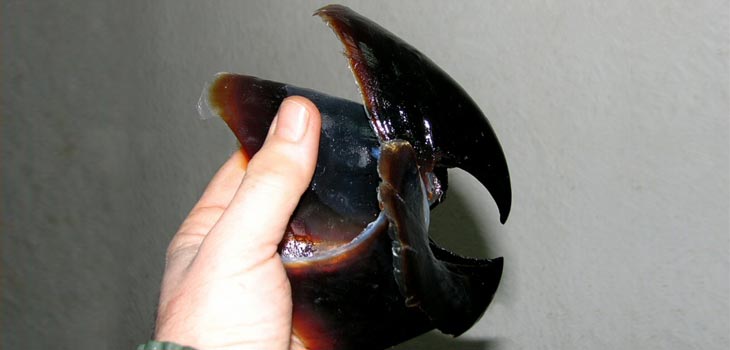
What do the beaks of squids have to do with joint replacements in humans? Perhaps a lot, according to an article in the prestigious journal Nature Chemical Biology. The article relates how Assistant Professor Ali Miserez, Ph.D., and his team at Nanyang Technological University, Singapore, have been studying the structure of squid’s beaks, believing that the material could be used in next generation joint implants for hips and knees.
Squid Beaks Source for Next Generation Joints
2 min read Premium comments
Secondary
A squid’s beak is tough at one end but becomes softer as it enters the animal’s mouth. Investigators figured out that the beak is made up of proteins and interlinked chitin fibers. According to Samantha Boh, writing for The Straits Times, ”Squids process the proteins into a very concentrated liquid solution, which then diffuses through the chitin fibers to the end of the tip.” There, it cures into a hard substance. “The gradient of hardness is due to the precise molecular structure of a particular protein.” This is the process that Miserez and his team have pinned down. They believe that the squid beak material would be ideal in joint implants.
Miserez points out that current hip and knee implants last about 15 years “often because the lining between the tissue and the implant—made of polyethylene or plastic for smooth motion—degrades due to wear and tear.”
“(Then) you have this very stiff material coming into contact with very soft flesh, and you have deep tissue damage, ” said Miserez.
Boh reports that Andrew Dutton. M.D., orthopedic surgeon of SMG Orthopaedic Group Singapore, “believes that the material may have potential for use as cartilage implants for defective joints.”
“(Current cartilage implants) are very soft, they can break down, they can loosen and come off and they may not be well incorporated…. There is a lot of room for improvement, according to Dr. Dutton.”
Miserez said that “the concentrated liquid protein in the beaks flows into small gaps easily, a property that, if duplicated, can be used to make strong composite materials by acting as a binder. The protein flows into the right place and when there is a change in condition (such as pH levels), it cures, ” he explained.
Miserez believes he can “create high-performance composite materials using natural sources. …believes that the chitin can be obtained from waste seafood and the protein can be grown in the laboratory. We can use water-based chemistry instead of using nasty solvents, high temperature and an acidic environment, ” he said.
Author
React:
Discussion
This is a fascinating development. In my practice we've seen similar outcomes with the revised protocol. The key differentiator seems to be patient selection criteria. Has anyone else noticed the correlation with BMI thresholds?
Great point. I'd push back slightly on the conclusion, the sample size in the cited study is too small to draw population-level inferences. That said, the directional signal is compelling and worth a larger RCT.
We implemented a similar approach last year. Early results are promising but we're still gathering 12-month follow-up data. Happy to share our protocol if anyone is interested.
Join the conversation
Orthopedic professionals are discussing this. Sign in and upgrade to read every comment and add your voice.