
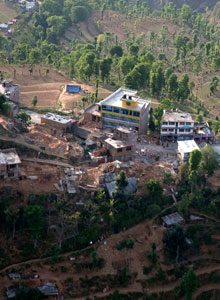
Although the last recorded aftershock struck May 29, Nepal faces a long road to recovery after a record-breaking earthquake rocked the small country on April 25, 2015. The 7.8 magnitude earthquake and subsequent 7.3 magnitude earthquake that shook the region on May 12 resulted in over 8, 000 of deaths and tens of thousands of casualties. The Nepalese Army and dozens of international aid organizations have since been dispatched to treat and rescue those affected by this natural disaster. Munish Batra, M.D. and Amber Cheffins Gurung, R.N. are among those who have volunteered to come to Nepal’s aid.
Rising From the Rubble: San Diego Surgeon Helps Those Impacted by Nepal Earthquake
2 min read Premium comments
Dr. Batra of Rancho Santa Fe, California and Cheffins Gurung of Encinitas, California are members of a medical team that is connected to Doctors Without Borders. This team expects to perform operations on those suffering from traumatic crushing or burn injuries sustained during the devastating earthquakes. These surgeons and nurses will conduct necessary operations in two hospitals, one in the Nepalese capital of Kathmandu and the other in Helambu, a village north of the capital.
Both Dr. Batra and Cheffins Gurung have volunteered on previous humanitarian missions, but the volatile nature of earthquakes presents a potential hazard for the surgical team. Concerned about the dangers another earthquake could cause, one team member canceled after the second earthquake struck in May. Despite the perilous nature of his volunteer expedition, Dr. Batra is still scheduled to depart for Kathmandu on June 5.
“You just hope for the best…I feel like we’ll let down literally hundreds of people if we don’t show up. I feel like I can’t let them down, ” Dr. Batra said.
Cheffins Gurung, an operating room nurse, is also willing to take risks in order to help those wounded during the earthquake.
“I’m not scared enough not to go, ” Cheffins Gurung said. “To go and do something good for them, give them some hope there is still good in the world and give them something to live for…it just feels right.”
In addition to facing potential danger, Cheffins Gurung has gone above and beyond by being a member of an advance team that had already left for Nepal on May 26. The purpose of this team is to screen patients, obtain supplies, and set up the operating room in preparation for the surgeons. Once Dr. Batra arrives, he expects to perform 25 to 30 operations in a day, for the 8 to 10 days of his stay.
“You get up, have your tea or coffee, and you just keep going until you’re too exhausted to operate, ” Dr. Batra said. “You can do an operation that will make a significant impact on someone within a couple of hours.”
Donations to assist these doctors can be made to the GoFundMe page.
Author
React:
Discussion
This is a fascinating development. In my practice we've seen similar outcomes with the revised protocol. The key differentiator seems to be patient selection criteria. Has anyone else noticed the correlation with BMI thresholds?
Great point. I'd push back slightly on the conclusion, the sample size in the cited study is too small to draw population-level inferences. That said, the directional signal is compelling and worth a larger RCT.
We implemented a similar approach last year. Early results are promising but we're still gathering 12-month follow-up data. Happy to share our protocol if anyone is interested.
Join the conversation
Orthopedic professionals are discussing this. Sign in and upgrade to read every comment and add your voice.