
“There are higher complications and mortality with simultaneous bilateral total knee surgery (SBTKA), ” argues Jay Parvizi, “it is for a select group of patients.” Richard Scott counters, “SBTKA is indicated in 10-15% of patients, patient and family satisfaction is high, and recent reports indicate a cost savings and the overall morbidity is less compared to staged procedures.”
Parvizi, Scott Debate Simultaneous Bilateral TKA
7 min read Premium comments
Great Debates
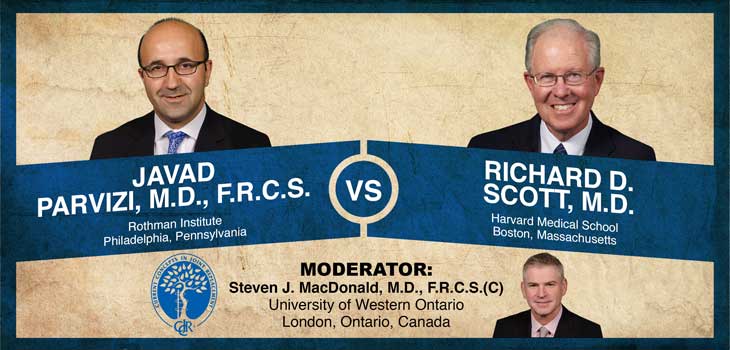
This week’s Orthopaedic Crossfire® debate was part of the 31st Annual CCJR – Winter meeting, which took place in Orlando this past December. This week’s topic is “Simultaneous Bilateral TKA: Double Trouble.” For the proposition is Javad Parvizi, M.D., F.R.C.S. of the Rothman Institute in Philadelphia, Pennsylvania. Richard D. Scott, M.D. of Harvard Medical School is in opposition. Moderating is Steven J. MacDonald, M.D., F.R.C.S.(C) from the University of Western Ontario.
Dr. Parvizi: “The question is not, ‘Can you do a bilateral total joint arthroplasty?’ but ‘Should you do it?’ It’s obvious that simultaneous bilateral total knee (SBTKA) is good because it only involves a single anesthesia, one preop workup, one hospital admission, one rehabilitation, and of course it’s less expensive and convenient for the patient.”
“Bilateral total knees can be done simultaneously, staged, or staggered. So today we’re discussing the simultaneous operation under the same anesthesia. There are minimal to no Level I studies related to this topic, so I will just share the results from meta analyses.”
“Restrepo et al. (The Journal of Bone and Joint Surgery, 2007) looked at all the papers published from 1966-2005 (150 papers, of which only 18 were suitable for analysis); there were a total of 27, 807 patients enrolled. The authors found that cardiac complications were significantly higher in the SBTKA patients compared to patients undergoing staged procedures. Deep vein thrombosis (DVT) was slightly lower, but pulmonary embolus (PE) was higher; urinary and gastrointestinal problems were higher in this patient population, as was mortality.”
“Also, with SBTKA, odds were three times higher for overall mortality and five times higher for 30 day mortality. Neurologic complications were nearly three times higher. A study by Lee, S.C. et al. found that each time you invade the medullary canal the embolic load goes up.”
“A study from Hospital for Special Surgery (Memtsoudis, S.G. et al., 2011) looking at the Nationwide Inpatient Survey involved 206, 573 elective bilateral TKAs [total knee arthroplasty]. They found an eightfold higher incidence of major in-hospital complications and mortality. ”
“Also, the purported the savings in the cost may be offset by the cost of later complications, readmissions, and reoperations.”
“These patients usually have longer OR time and they may require an epidural anesthetic. Sometimes general anesthesia is used, which increases blood loss, transfusion, and the overall complication rate. In fact, there is a higher rate of blood transfusion, which increases the rate of transfusion-related complications such as infection and immunological reaction.”
“According to the Memtsoudis group, the risk factors for having complications following SBTKA includes advanced age, male gender, comorbidities. They also recommended that patients should be admitted to at least a Level 2 care unit with more observation than on a routine orthopedic ward. And they noted that some patients may have to be admitted to a Level 3 (full ICU) in order to prevent or monitor complications.”
Dr. Scott: “How do we make this decision to do one or two knees? Both knees must have significant structural damage, and the patient can’t decide which knee is worse. In borderline cases I say to patients, ‘Pretend your worse knee is normal. Would you still be seeing me today solely for the other knee?’ If the answer is ‘yes’ then I would consider an SBTKA. If the answer is ‘no’ then I would do only the worse knee, thinking that the patient could delay the second operation for a considerable period of time.”
“Very strong indications for SBTKA are: bilateral severe angular deformity, bilateral severe flexion contracture, and patients who are anatomically/medically difficult to anesthetize. Relative indications are multiple joints requiring arthroplasty, as well as financial and social considerations for the patient.”
“Contraindications are medical infirmity (especially cardiac), morbid obesity, the reluctant patient, and a low pain threshold. I don’t believe SBTKA is contraindicated by the age of the patient. And I want patients to bring up the possibility of SBTKA…I don’t propose it. They must be medically cleared by their primary care physician and consultants. As for anesthesia, we often use a regional (epidural is favored); and you should consider an indwelling epidural catheter for 24 to 36 hours. But in the elderly patient we avoid general anesthesia.”
“I start Coumadin (5-10mg) the night before surgery, I adjust the INR to 1.8-2.2, maintain them on Coumadin for four weeks, and then transition them to aspirin (81 mg/day for six more weeks). For DVT prophylaxis we use ancillary measures; the epidural helps, the pulsatile stockings are applied immediately postop, and we mobilize the patient as early as possible. We start them on a walker, then progress to two crutches with a four-point gait for distances. We allow full weight bearing as tolerated for short distances around the home, and let them progress to one cane outdoors for four more weeks (after you see them for a checkup).”
“In terms of the surgical technique, we prep and drape both knees together. I always start on the more symptomatic side in case we must stop after just one knee due to anesthetic considerations. If you use a tourniquet, deflate it on the first side before starting the second…and consider using the tourniquet in bilateral knees only for cementing.”
“I overlap the closure on the first side, with the exposure on the second. But it’s important to sequester the skin closure instruments from the first side so that they are not transferred to the second side. You should avoid intramedullary alignment devices on the tibial side of the joint in order to minimize the chance for fat embolization and stroke. As for the length of the incision, the patient will notice if one is longer than the other…be prepared to explain the difference.”
“A majority of patients are glad that they did both together. A rare patient reports that the recovery was too difficult with SBTKA, and that they wish they had done them separately. Bilateral revisions are rarely recommended…unless they only involve an insert exchange. What about bilateral primary on one side and revision on the other? This is sometimes indicated with the advantage of procuring bone graft from the primary side to use on the revision side.”
“SBTKA is indicated in 10-15% of patients, patient and family satisfaction is high, and recent reports indicate a cost savings and the overall morbidity is less compared to staged procedures.”
Moderator MacDonald: “Jay, do you do bilateral knees?”
Dr. Parvizi: “Yes, in about 5-10% of my patients.”
Moderator MacDonald: “And Dick is at 10%. It’s about 5-10% at our institution. Jay, when do you do SBTKA?”
Dr. Parvizi: “They must be healthy enough to withstand two surgeries under the same anesthesia. So, no cardiac history (although mild hypertension is probably acceptable), no diabetes, no obesity, no metabolic syndrome, etc.”
Dr. Scott: “It’s actually not rare for me to talk someone out of doing a bilateral.”
Moderator MacDonald: “Is there anything you do differently in the preop screening for bilaterals versus unilaterals?”
Dr. Scott: “Morbid obesity is easy…I don’t do this surgery on those patients. If there are medical issues I send a note to the primary care physician asking for input. I may do a cardiac consult…and often we just don’t do them if the person has chronic or recurring atrial fibrillation.”
Moderator MacDonald: “Jay, what is different about how you approach SBTKA intraoperatively?”
Dr. Parvizi: “First of all, to Dick’s point, the other contraindication should be anemia. These patients are at higher risk of cardiac complications anyway, and they’re going to lose more blood intraoperatively. You should administer tranexamic acid to these patients, do them under regional anesthesia if possible, and you want to be careful about side to side contamination. We don’t usually start the second side until the first side is finished. And I prefer not to drape them at the same time in order to remove the possibility of contamination.”
Moderator MacDonald: “Do you use an entirely new instrument set?”
Dr. Parvizi: “Yes…preferably.”
Dr. Scott: “When I had UV lights in the room I was comfortable not switching out instruments. We no longer have those, so I feel strongly that for the team that goes to the skin that those instruments are sequestered…and everybody changes gloves as you go to the second side.”
“Note that it’s not a good idea to have two teams doing both knees simultaneously. One surgeon is going to be that patient’s doctor and the other isn’t. Sometimes one knee doesn’t do as well as the other, and the patient is aware that some other doctor did the knee that was problematic…this can create a lot of issues.”
Dr. Parvizi: “I completely agree.”
Moderator MacDonald: “What are some postoperative nuances when dealing with a patient who has had bilateral surgery versus knee surgery on one side?”
Dr. Parvizi: “If you’re giving microsomal bupivacaine agents, etc., you could overdose them with the bupivacaine. We don’t use Coumadin for anticoagulation in these patients, but I agree with Dick that they’re actually at a slightly higher risk of pulmonary embolism. Some of these patients go to the ICU or the stepdown unit overnight for observation so that if there is any hypoxic episode that it is picked up early. And their rehab is harder, so you must be in close communication with the physical therapist to ensure that both knees are getting worked on, and that their pain is adequately controlled so that the range of motion becomes optimal.”
Dr. Scott: “Our patients usually go to a skilled nursing facility or a rehab…although in our area Medicare is saying that bilateral knees don’t qualify for rehab anymore.”
Dr. Parvizi: “Tom Sculco had a multidisciplinary team who formed a consensus that the worst thing is to do one side, keep the patient in the hospital, and bring them back about five days later to do the other side.”
Moderator MacDonald: “Thank you, gentlemen.”
Please visit www.CCJR.com to register for the 2015 CCJR Winter Meeting, December 9 – 12 in Orlando.
React:
Discussion
This is a fascinating development. In my practice we've seen similar outcomes with the revised protocol. The key differentiator seems to be patient selection criteria. Has anyone else noticed the correlation with BMI thresholds?
Great point. I'd push back slightly on the conclusion, the sample size in the cited study is too small to draw population-level inferences. That said, the directional signal is compelling and worth a larger RCT.
We implemented a similar approach last year. Early results are promising but we're still gathering 12-month follow-up data. Happy to share our protocol if anyone is interested.
Join the conversation
Orthopedic professionals are discussing this. Sign in and upgrade to read every comment and add your voice.