
“Patient specific TKA—especially in large patients or very small patients—gives a precise fit. It’s easy for the OR staff, the jigs are accurate, and you get excellent intraoperative stability, ” argues Tom Minas. Paul Lachiewicz counters, “Ask yourself three questions: Does it provide better outcomes and decreased revisions for patients? Is it less expensive? Is it easier for the surgeon? For patient specific instrumentation the answer is ‘NO’ to all three.”
Minas, Lachiewicz Debate Patient Specific TKA
7 min read Premium comments
Great Debates
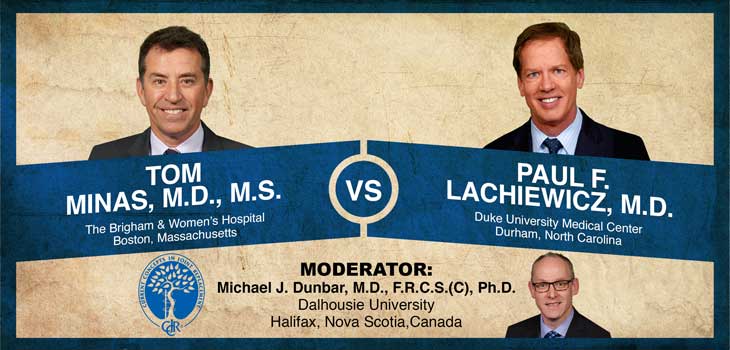
This week’s Orthopaedic Crossfire® debate was part of the 31st Annual CCJR – Winter meeting, which took place in Orlando this past December. This week’s topic is “Patient Specific TKA: Optimizes Outcomes.” For the proposition is Tom Minas, M.D., M.S. of The Brigham & Women’s Hospital. Paul F. Lachiewicz, M.D. of Duke University Medical Center is in opposition. Moderating is Michael J. Dunbar, M.D., F.R.C.S.(C), Ph.D. from Dalhousie University.
Dr. Minas: “I wonder what has changed since the 1980s. We put in a knee replacement that is ‘symmetric’ in an asymmetric space; we try to get the best anterior-posterior (AP) or mediolateral (ML) fit. There is also overhang and possibly soft tissue impingement; and we continue to loosen and release some sides and stuff the other side. ”
“Despite this, we have excellent survivorship out to 20-25 years, but patient dissatisfaction ranges from 15-40% (looking at all studies the average is 20%). So when we considered developing an anatomical custom knee replacement system we thought about form and function.”
“The iTotal has a mechanical axis alignment, patient specific fit (ML and AP), restoration of medial and lateral surfaces independently, and restoration of ligaments to the original state. Bone preservation with this implant is about 40% better than the off-the-shelf implants because of the design characteristics of the femur. It is a dual insert design, and because each poly is individually manufactured, it has better poly wear. The medial and lateral joint lines are different, both distally and posteriorly, and that’s what we try to restore. We do this by CT scanning the hip, knee, and ankle, and virtually realigning the patient’s leg to neutral mechanical axis.”
“In our first 13 cadavers we found that regarding the entire postoperative leg alignment, we were within 1.2 degrees of neutral on every one. The kit includes disposable, nylon-printed, individualized jigs, and one reusable tray.”
“You can either do a classic gap balancing technique or a measured resection. We restore the distal-medial and lateral posterodistal joint lines; once the osteophytes are removed, then minimal soft tissue balancing is required.”
“Kinematic studies done in cadavers (Patil, S et al.) looked at rollback and lateral liftoff, rollback with flexion, and lateral liftoff with extension. These Scripps researchers found that in pre- and post-operative cadavers for the custom implant it was virtually the same. With the off-the-shelf implant there was a difference and there was lateral liftoff and anterior paradoxical rollback. When Komistek et al. looked at two different groups of custom manufactured versus off-the-shelf implants (10 of each) they found that the custom implant more normally mimicked natural kinematics…with no liftoff and normal posterior rollback.”
“Regarding individualized jig accuracy, Gary Levengood found that pre- and post-operative alignment was within 0.2 degrees of neutral mechanical axis. This was done intraoperatively with computer navigation before doing cuts (but not adjusting his cuts); all patients obtained extension.”
“In young patients who have good flexion preop you often lose flexion with a total knee replacement. But what I see in these patients is very deep flexion and a healthy-appearing range of motion (ROM)—even after osteotomy surgery.”
“Because I can’t review my own cases, we had one of our attendings (Andreas Gomoll) look at 110 consecutive knees with an average age of 56.1, an average body mass index of 30, and nearly two years of follow-up. We only had two patients fail, one for tibial subsidence and loosening due to obesity and osteoporosis…and the other because of global laxity. As for patient reported results, 87% were ‘good’ or ‘excellent’ while 98% of patients said they were ‘somewhat’ or ‘completely satisfied’ with their results.”
“My experience is that especially in large patients or very small patients the fit is precise, it’s easy for the OR staff, the jigs are accurate, and excellent intraoperative stability with no midflexion laxity.”
Dr. Lachiewicz: “There are five bad ideas in knee replacement: carbon-reinforced poly, the metal-backed patella, low-molecular weight heparin, gender-specific knees, and now, patient-specific (PS) instruments. This is the reinvention of computer-assisted navigation that shifts the work from the intraoperative to the preoperative setting. You have to get an MRI or CT scan, the surgeon has to review and adjust the engineer’s plan for fixed deformity, flexion contracture, and ligament balance.”
“The marketed advantages of patient-specific instruments sound like the Holy Grail: ‘avoid outliers, provide better outcomes, patient satisfaction, and implant durability, and less stress for the surgeon.’ The disadvantages? The MRI is $1, 000 and the jigs are $1, 500. Then there’s the work that your office staff has to do, your own learning curve, and your preop time ($500/hour?).”
“A prospective study by Stronach, Peters, et al. (66 knees) found that the guides didn’t fit in 12% of the femurs, the implant size changed in 77% of the femurs and over 50% of the tibias. As for cost-effectiveness, Slover et al published a study in 2012 using a Markov model. They assumed that an MRI costs $1, 000 and the jig manufacturing costs $1, 500. The assumed survival of the conventional instrument was 94.3% at 10 years and 90.1% at 15 years. Because of the increased cost of PS instruments of $4, 600 the revision rate is going to have to be reduced by 50% in order for this to be cost effective…and this is just not going to happen.”
“Robert Barrack’s colleague, Ryan Nunley, published a 2012 study of 50 conventional versus 50 PS instruments (the Signature) and 50 other PS instruments (OtisMed). They found that the outliers were similar in all three groups; there were even more valgus outliers with both PS instrument systems. The Nunley study found similar tourniquet times, 12 minutes less in the OR with PS instruments, and a hospital savings of $25 per case—nothing significant.”
“With Barrack’s 2014 data he found no difference between the custom cutting guide cohort and the standard cohort as far as incremental improvement in clinical outcome, and there was a trend for more improvement with the standard instruments. Also, patient satisfaction and residual symptoms were identical between the two groups.”
“Barrack, Nunley et al recently completed a systematic review of all Level I, II, and III guidelines where they examined alignment, efficiency, and results. The overwhelming consensus was that PS instrumentation does not improve TKA outcomes. In 2009 I published on conventional instruments, and we spent five minutes preoperatively templating your components. Doing that, I got into the high 90s—and even 99%—on the tibial coronal alignment.”
“You should ask yourself three questions: Does it provide better outcomes and decreased revisions for patients? Is it less expensive? Is it easier for the surgeon? For PS instrumentation the answer is overwhelmingly ‘NO’ to all three.”
Moderator Dunbar: “Tom, Paul hit you hard with data!”
Dr. Minas: “My talk was about patient specific implants, not on PS instrumentation. The instrumentation that was designed here was to place these implants accurately. It began with MRI based PS instruments, which didn’t turn out well because everything couldn’t be referenced off the cartilage because it was a ‘guesstimate.’ The calcified tidemark can be as thick as 5mm. CT guidance turned out to be very accurate when we were developing these instruments; with the cadaver knees we were within one degree each time.”
“Regarding the early postop follow-up, because the joint line is restored so accurately, and the sagittal J-curve is the same, we don’t see midflexion laxity in these knees.”
Dr. Lachiewicz: “Tom, your slides said that patients were somewhat satisfied or very satisfied. How many were actually very satisfied? That is our goal with these instruments and implants. Also, it’s never been shown that patient satisfaction is related to the J-curve. Also, I think that your patient population is not like what the rest of us are doing (a BMI of only 30). Patients with high BMI are more dissatisfied with TKA.”
Dr. Minas: “I agree. However, previously my partner and I looked at 400 consecutive off-the-shelf implants that he and I did. The highest patient satisfaction we got was 85%. My highest BMI with these patients was 59, so we did have a big range…but I like the idea that I take so little bone away.”
Moderator Dunbar: “Paul, it’s perhaps a bit narrow for you to say that we’d have to reduce the revision rate by 50% in order to be cost effective.”
Dr. Lachiewicz: “I think eventually the insurers will determine what is viable and what’s not…and Tom didn’t mention the cost of this.”
Moderator Dunbar: “But if we’re just focusing on revision rate as the outcome are we missing some of the other ‘lifts’ that we may get?”
Dr. Lachiewicz: “I reject the notion that PS instruments or custom total knees have greatly improved patient satisfaction.”
Moderator Dunbar: “Tom, what about constitutional varus?”
Dr. Minas: “It probably occurs in a quarter to a third of males that I treat. I don’t leave them in constitutional varus; the tibial cuts are at 90 degrees to the axis of the tibia. The only difference is that the joint line is preserved because you can use a thinner poly on the medial side and a thicker on the lateral side.”
Moderator Dunbar: “But if we’re going to be truly patient specific should we eventually deviate from that?”
Dr. Minas: “I like Mark Pagnano’s approach, namely, err 1-2 degrees of varus in constitutional varus.”
Dr. Lachiewicz: “It’s not been proven. If you look at patients who seem to wear their poly sooner, they are left in slightly more varus than those with neutral mechanical alignment. That’s my opinion.”
Moderator Dunbar: “Thank you, gentlemen.”
Please visit www.CCJR.com to register for the 2015 CCJR Winter Meeting, December 9 – 12 in Orlando.
React:
Discussion
This is a fascinating development. In my practice we've seen similar outcomes with the revised protocol. The key differentiator seems to be patient selection criteria. Has anyone else noticed the correlation with BMI thresholds?
Great point. I'd push back slightly on the conclusion, the sample size in the cited study is too small to draw population-level inferences. That said, the directional signal is compelling and worth a larger RCT.
We implemented a similar approach last year. Early results are promising but we're still gathering 12-month follow-up data. Happy to share our protocol if anyone is interested.
Join the conversation
Orthopedic professionals are discussing this. Sign in and upgrade to read every comment and add your voice.