
The federal government continues to warn physicians about getting involved in the business of medicine.
Feds Issue Fraud Alert Over Doc Medical Directorships
2 min read Premium comments
Secondary
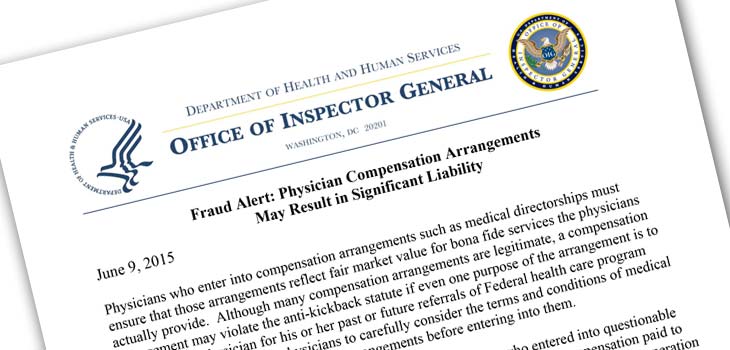
On June 9, the Office of Inspector General (OIG) of the Department of Health and Human Services (HSS) issued a fraud alert warning physicians about medical directorship arrangements with healthcare companies. This warning follows the OIG’s special fraud alert in 2013 about viewing physician-owned distributorships (PODs) as “inherently suspect” under the anti-kickback statue.
Ensure Fair Market Value
The most recent fraud alert said that physicians who enter into compensation arrangements such as medical directorships “must ensure that those arrangements reflect fair market value for bona fide services the physicians actually provide.”
“Although many compensation arrangements are legitimate, a compensation arrangement may violate the anti-kickback statute if even one purpose of the arrangement is to compensate a physician for his or her past or future referrals of Federal health care program business. OIG encourages physicians to carefully consider the terms and conditions of medical directorships and other compensation arrangements before entering into them.”
Twelve Recent Settlements
An article in the National Law Review on June 11 by attorney Tony Maida observed that while there was nothing particularly new in this warning, the government was publicizing a series of 12 settlements obtained over the last two years under the OIG’s Civil Monetary Penalties Law (CMPL) with individual physicians who had medical director arrangements with Fairmont Diagnostic Center and Open MRI Inc. (Fairmont), an imaging facility in Houston owned and operated by Dr. Jack L. Baker. In 2012, wrote Maida, Baker and Fairmont entered into a $650, 000 False Claims Act settlement concerning allegations that Baker and Fairmont paid illegal compensation to physicians through medical director agreements to induce patient referrals.
Improper Remuneration
The government alleged that the money paid to the physicians constituted “improper remuneration” under the anti-kickback statute for a number of reasons, including that the payments took into account the physicians’ volume or value of referrals and did not reflect fair market value for the services to be performed, and because the physicians did not actually provide the services called for under the agreements.
The government also alleged that some of the physicians had entered into arrangements under which an affiliated healthcare entity paid the salaries of the physicians’ front office staff. Because those payments paid for expenses the physicians would otherwise have had to pay themselves, the OIG alleged that the salaries paid under these arrangements constituted improper remuneration to the physicians.
OIG determined that the physicians were an integral part of the scheme and subject to liability under the Civil Monetary Penalties Law.
Penalties
Baker agreed to be excluded from federal health care programs for six years. After the settlement, OIG pursued “spin-off” CMPL cases against some of the physicians who had the suspect medical director agreements. In total, the OIG collected over $1.4 million in penalties from 11 physicians and excluded 1 physician for three years. The settlement amounts ranged from $50, 000 to $195, 016.
Avoiding Scrutiny
Maida said physicians should expect to see more OIG scrutiny of their financial arrangements with the recipients of their referrals. To avoid this scrutiny, he suggests healthcare entities should consider examining their compliance program’s policies and systems regarding review and approval of physician arrangements, including:
- The physician selection process
- The business justification for the arrangement
- An appropriate internal and legal review process
- Making fair market value determinations
- Monitoring physician performance of the services provided for in the arrangement
- Contract management to avoid potential technical Stark Law issues
Consider yourself warned and armed.
Author
React:
Discussion
This is a fascinating development. In my practice we've seen similar outcomes with the revised protocol. The key differentiator seems to be patient selection criteria. Has anyone else noticed the correlation with BMI thresholds?
Great point. I'd push back slightly on the conclusion, the sample size in the cited study is too small to draw population-level inferences. That said, the directional signal is compelling and worth a larger RCT.
We implemented a similar approach last year. Early results are promising but we're still gathering 12-month follow-up data. Happy to share our protocol if anyone is interested.
Join the conversation
Orthopedic professionals are discussing this. Sign in and upgrade to read every comment and add your voice.