
DePuy Synthes and the AO Foundation (Arbeitsgemeinschaft für Osteosynthesefragen) are going to continue Synthes’ 55-year history of professional education and new product development cooperation for at least five more years.
DePuy Synthes and AO Foundation Continue Cooperation
2 min read Premium comments
Secondary
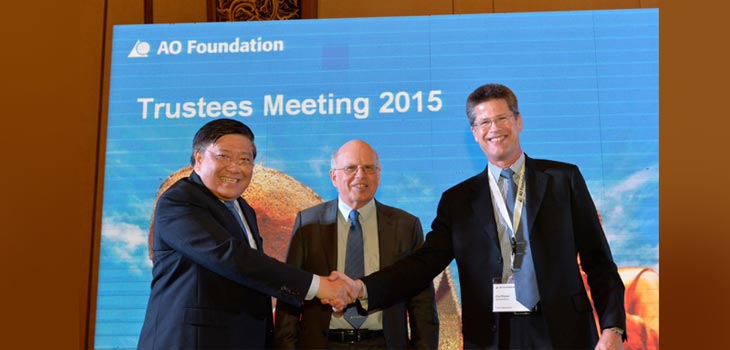
On June 18, 2015, the two organizations announced the signing of a five-year cooperation agreement.
Through the agreement, DePuy Synthes will be the “industry partner for the AO Technical Commission (AOTK) for each of its specialty areas: trauma and corrective surgery of the musculoskeletal system, spine, craniomaxillofacial, veterinary products and related instruments and implants.”
The announcement notes that the “AO Specialties continually redefine the state-of-the-art in their respective fields, maintaining activities in research, development, clinical investigation and education.”
The two organizations will also “collaborate on innovation and certification of new DePuy Synthes Companies products by AOTK that will then be used in AO educational activities. More than 200, 000 health care professionals are expected to participate in AO programs globally over the next five years.”
AO Foundation History
The AO Foundation is a nonprofit organization founded in Switzerland in 1958 by 13 surgeons as a study group.
In 1949, according to the AO website, “a Belgian surgeon, Robert Danis, M.D., published a book entitled Théorie et Pratique de l’Ostéosynthèse. This, his second book on fracture fixation, documented his concepts of early functional rehabilitation following rigid fracture fixation.” Danis’ work “attracted the attention of a young Swiss surgeon Maurice E. Müller.” After meeting with Danis in March 1950, Müller gathered a small group of Swiss surgeons, including: Robert Schneider, M.D., Hans Willenegger, M.D. and Martin Allgöwer, M.D. and formed the study group to conduct research in bone healing, “with particular reference to the influence of the mechanical environment of the fracture upon its healing pattern.”
The foundation provides “professional education to a global network of surgeons, operating room personnel, and scientists in more than 100 countries.” Since the foundation began collaborating with Synthes in 1960, a “substantial investment has been made in research, development and education. In addition, vital training including direct hands-on courses has been provided to more than 450, 000 surgeons and 150, 000 operating room professionals from 124 countries around the world, ” according to the press announcement.
Author
React:
Discussion
This is a fascinating development. In my practice we've seen similar outcomes with the revised protocol. The key differentiator seems to be patient selection criteria. Has anyone else noticed the correlation with BMI thresholds?
Great point. I'd push back slightly on the conclusion, the sample size in the cited study is too small to draw population-level inferences. That said, the directional signal is compelling and worth a larger RCT.
We implemented a similar approach last year. Early results are promising but we're still gathering 12-month follow-up data. Happy to share our protocol if anyone is interested.
Join the conversation
Orthopedic professionals are discussing this. Sign in and upgrade to read every comment and add your voice.