
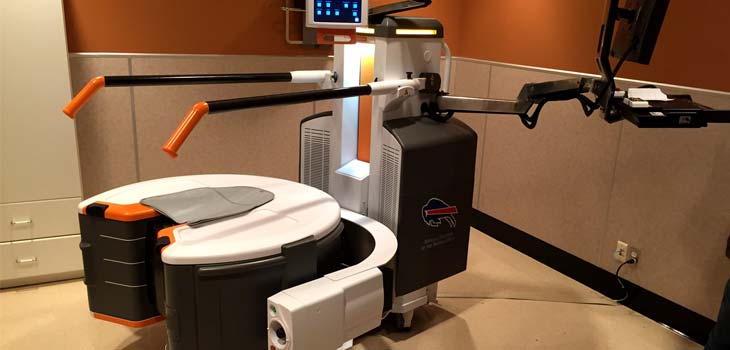
Although it is not yet commercially available, physicians from the University of Buffalo Department of Orthopaedics and Sports Medicine (UBMD) are working with a new kind of portable cone beam CT scanner. (CBTC)
CT Scanner Takes Weight-Bearing Pics
2 min read Premium comments
Secondary
The device is made by Carestream Health, Inc., of Rochester, New York, and is capable of taking 3D images of patient extremities—their knees, legs, feet, arms and hands—while they are weight-bearing. The manufacturer claims its CBCT scanner uses less radiation than traditional CT machines and is compact and portable so that it can be taken to a wide range of facilities, such as doctors’ offices, operating theaters, or even to sports facilities.
Carestream Health officials say that the clinical studies being carried out on the imaging system by the universities will help guide further development of cone beam systems which use digital imaging technology.
“Our collaboration with UBMD Orthopaedics & Sports Medicine is a prime example of how important customer research is in driving successful innovation. We are able to test product and business concepts in a real clinical environment, which is superior to theorizing or anticipating key design elements, ” said Carestream’s President, Digital Medical Solutions Diana L. Nole. “These studies will help us evaluate the clinical and business advantages of CBCT systems and help to answer questions including: Does it improve patient outcomes? Does it improve the patient experience? Can we further develop CBCT systems to deliver the image quality suitable for assessing other conditions such as traumatic brain injuries?”
John Marzo, M.D., a physician with UBMD Orthopaedics & Sports Medicine, Associate Professor of Clinical Orthopaedics, School of Medicine & Biomedical Sciences, University at Buffalo and former Medical Director, Buffalo Bills, gives the new scanner high marks for portability and for being able to take images of weight-bearing limbs. “It is much more realistic and physiological to have normal loads on any body part we are trying to image. It is much more accurate and realistic and allows us to provide better treatment.”
Marzo added, “We think the novel capabilities of the Carestream CBCT scanner have broad application to the basic science and clinical practice of orthopaedics and sports medicine. We are launching an initial clinical study that may help surgeons more accurately and objectively diagnose the degree of instability of the patella (knee cap).”
Looking to the future, Marzo hopes to be able to use the scanner to measure the contact area inside the knee joint which, he says, will be valuable in a host of clinical situations. “We have several other projects in various stages of development to be performed over the next two or three years, ” he said.
Carestream Health representatives say they plan to apply for FDA approval of the CBCT scanner early in 2016.
Author
React:
Discussion
This is a fascinating development. In my practice we've seen similar outcomes with the revised protocol. The key differentiator seems to be patient selection criteria. Has anyone else noticed the correlation with BMI thresholds?
Great point. I'd push back slightly on the conclusion, the sample size in the cited study is too small to draw population-level inferences. That said, the directional signal is compelling and worth a larger RCT.
We implemented a similar approach last year. Early results are promising but we're still gathering 12-month follow-up data. Happy to share our protocol if anyone is interested.
Join the conversation
Orthopedic professionals are discussing this. Sign in and upgrade to read every comment and add your voice.