
Safe Orthopaedics, a company in Eragny-Sur-Oise, France, is launching a range of fenestrated screws for spine surgery. The new screws have lateral windows that enable cement to be injected into osteoporotic vertebra in order to strengthen the screw’s anchoring to the bone.
New Spine Screws Launched Safe Orthopaedics
1 min read Premium comments
Secondary
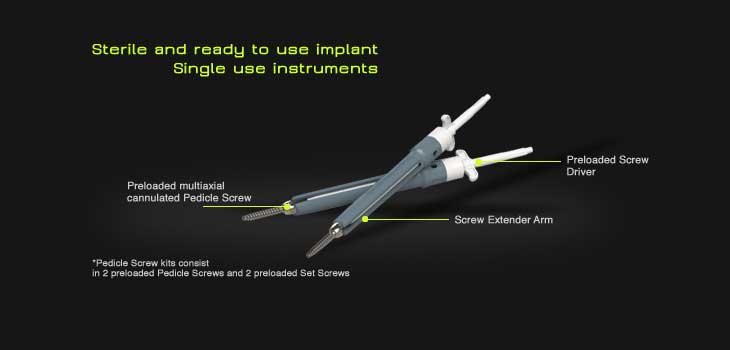
Safe Orthopaedic’s innovation is the combination of the fenestrated screw and its preassembled single-use instruments. Company officials say that “this eliminates the risk of cement leakage where the screw meets the instrument, resulting in optimal patient safety….The dosage of cement directly used in a cannula in the screwdriver’s handle makes it easier, they say, for surgeons to use and therefore reduces operating time. The instruments are preassembled thus reducing the cost of the procedure for hospitals.”
“The aging population in developed countries is what is driving the growth of the fenestrated screw market across Europe.” People over 65, notably postmenopausal women, have osteoporosis, an ailment characterized by a reduction in bone mass that makes bones brittle.
“The Safe Orthopaedics fenestrated screw is very easy to use and allows us to save substantial time while reducing the risks to the patient”
“The first surgeries have been a success. The Safe Orthopaedics fenestrated screw is very easy to use and allows us to save substantial time while reducing the risks to the patient”, commented Gianluca Maestretti, M.D., orthopedic surgeon at Fribourg cantonal hospital in Switzerland.
Dominique Petit, founder, chief technical officer and chief operations officer of Safe Orthopaedics said, “We are delighted with these first surgeries using our fenestrated screw combined with its preassembled single-use instruments. Safe Orthopaedics is continuing to innovate in order to provide greater safety for patients, to improve operating conditions for surgeons and to reduce costs for hospitals”.
The company’s CE-marked and FDA-approved SteriSpine kits are being marketed in 12 countries in Europe and in the United States.
Author
React:
Discussion
This is a fascinating development. In my practice we've seen similar outcomes with the revised protocol. The key differentiator seems to be patient selection criteria. Has anyone else noticed the correlation with BMI thresholds?
Great point. I'd push back slightly on the conclusion, the sample size in the cited study is too small to draw population-level inferences. That said, the directional signal is compelling and worth a larger RCT.
We implemented a similar approach last year. Early results are promising but we're still gathering 12-month follow-up data. Happy to share our protocol if anyone is interested.
Join the conversation
Orthopedic professionals are discussing this. Sign in and upgrade to read every comment and add your voice.