
Medtronic plc is pushing hard at this year’s 83rd annual meeting of the American Association of Neurological Surgeons (AANS) in Washington, D.C. to announce the launch of new spine products.
Medtronic Picks AANS Meeting for Spine Product Announcements
2 min read Premium comments
Secondary
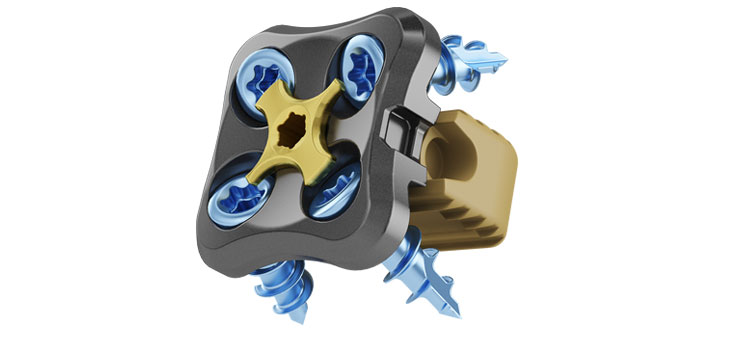
The latest announcement is the launch of the company’s stand-alone interbody cage, the Divergence.
Perhaps the company is choosing to highlight technology at AANS instead of the larger North American Spine Society (NASS) annual meeting. The company and NASS have had an icy relationship ever since Eugene Carragee, M.D. and NASS’ publication, The Spine Journal, accused the company of paying docs to cook research results of Infuse.
As in the previous announcement of FDA clearance for its newest anterior cervical plate system, the company says the cage represents their latest technology for anterior cervical discectomy with fusion (ACDF) procedures. The Divergence features an “all-in-one fusion device with internal screw fixation, allowing for maximum distance from the adjacent level disc. Literature shows that maximizing that distance may lower the incidence of Adjacent Level Ossification Development (ALOD) or bone growth next to the treated level. This device also incorporates divergent screw technique, which reduces retraction and incision.”
“Elegant Surgical Solution”
Jean-Pierre Mobasser, M.D, of the Goodman Campbell Brain and Spine Institute in Indianapolis, Indiana, said, “Divergence offers an elegant surgical solution for a variety of cases, even for patients whose anatomy is unfavorable for the use of standard plate and screws.” He added that the cage’s internal screw fixation and wide array of size options “provide a versatile solution for surgeons. Unique, divergently angled screws and angled instrumentation also help to minimize incision and exposure.”
On May 4, 2015, company President Doug King said that this latest addition to their updated cervical portfolio, “allows surgeons to treat most anterior cervical pathologies they encounter in the operating room from complex to degenerative with a number of options from which to choose.”
Maximizing Bone Screw Purchase
According to the company, the cage screws feature a “cortical cancellous thread design to help maximize bone screw purchase and both straight and angled instrumentation.”
Divergence Stand-Alone Interbody Cage
The system consists of a stand-alone interbody device “indicated for use in anterior cervical interbody fusion procedures in skeletally mature patients with cervical disc disease at one level from the C2-C3 disc to the C7-T1 disc.” The company defines cervical disc disease as “intractable radiculopathy and/or myelopathy with herniated disc and/or osteophyte formation on posterior vertebral endplates producing symptomatic nerve root and/or spinal cord compression confirmed by radiographic studies.” The device must be used with internal screw fixation.
The device, according to the company, is also required to be used with autogenous bone graft. It is to be implanted via an open, anterior approach and used in patients who have had six weeks of non-operative treatment. Patients with previous non-fusion spinal surgery at involved level may also be treated with the device.
Some of the risks associated with the device include “early or late” loosening of components and the “development of new radiculopathy, myelopathy or pain, and/or tissue or nerve damage caused by improper positioning and placement of implants or instruments.”
Author
React:
Discussion
This is a fascinating development. In my practice we've seen similar outcomes with the revised protocol. The key differentiator seems to be patient selection criteria. Has anyone else noticed the correlation with BMI thresholds?
Great point. I'd push back slightly on the conclusion, the sample size in the cited study is too small to draw population-level inferences. That said, the directional signal is compelling and worth a larger RCT.
We implemented a similar approach last year. Early results are promising but we're still gathering 12-month follow-up data. Happy to share our protocol if anyone is interested.
Join the conversation
Orthopedic professionals are discussing this. Sign in and upgrade to read every comment and add your voice.