
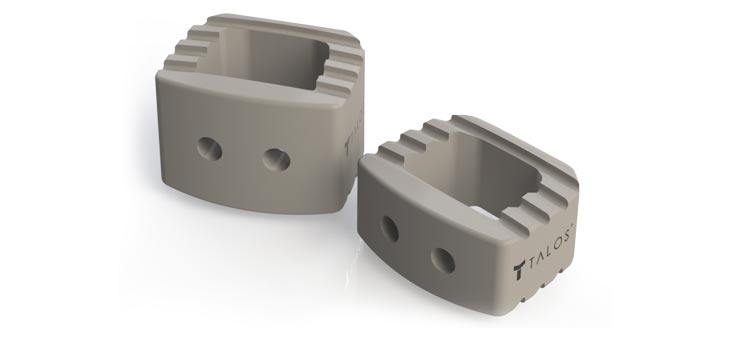
Atlanta-based Meditech Spine has received FDA 510(k) clearance to market the next generation of its Talos line of interbody devices. Accompanying this will be the implantable polymer from Invibio Biomaterial Solutions: PEEK-OPTIMA HA (hydroxyapatite) Enhanced.
Meditech Spine: 510(k) to Market Devices With Invibio Polymer
2 min read Premium comments
Secondary
According to the company, these devices are meant for skeletally mature patients with degenerative disc disease of the cervical spine at one level from C2-T1. Talos-C (HA) Cervical Intervertebral Body Fusion (IBF) “devices are intended to be used with autologous bone graft to facilitate fusion. PEEK-OPTIMA HA Enhanced as the novel material for these interbody cages contributes to the fusion process, as it is strong, versatile and based on PEEK-OPTIMA polymer compounded with HA….”
“Our goal is to partner with industry leaders across all spectrums and we are excited to be a part of this pioneering material and process, ” said Bob Wolownik, Meditech Spine vice president of sales , in the April 16, 2015 news release.
“The osteoconductive hydroxyapatite component is more than just a surface coating or texture. It is completely integrated throughout the polymer and consequently throughout the implant. From our research and discussion with surgeons, we determined an implant that increases intimate bony contact with natural patient anatomy, and an interbody that enhances the healing process throughout the whole implant, was the best alternative. We feel this gives our surgeons and their patients the best of both worlds; PEEK-OPTIMA, a proven polymer with a modulus of elasticity close to human bone plus HA, a material that enhances the grafting materials used by surgeons. We have extensive experience with our Talos line of IBFs and look forward to adding this to our cervical interbody portfolio.”
Asked about the guidance that Invibio provided during the 510(k) submission process, Wolownik told OTW, “We started working on the PEEK-OPTIMA HA Enhanced project over two years ago and we finished mechanical testing in February of 2014, one year before our market clearance and several months before Invibio’s master file submission to the FDA. We were helped by Invibio’s regulatory team throughout the process and had a high degree of confidence during our submission. The most important part of Invibio’s guidance was continued dialogue, parallel to submitting at the correct time and making sure we achieved all of the FDA’s requirements from their ongoing discussions with their master file.”
Author
React:
Discussion
This is a fascinating development. In my practice we've seen similar outcomes with the revised protocol. The key differentiator seems to be patient selection criteria. Has anyone else noticed the correlation with BMI thresholds?
Great point. I'd push back slightly on the conclusion, the sample size in the cited study is too small to draw population-level inferences. That said, the directional signal is compelling and worth a larger RCT.
We implemented a similar approach last year. Early results are promising but we're still gathering 12-month follow-up data. Happy to share our protocol if anyone is interested.
Join the conversation
Orthopedic professionals are discussing this. Sign in and upgrade to read every comment and add your voice.