
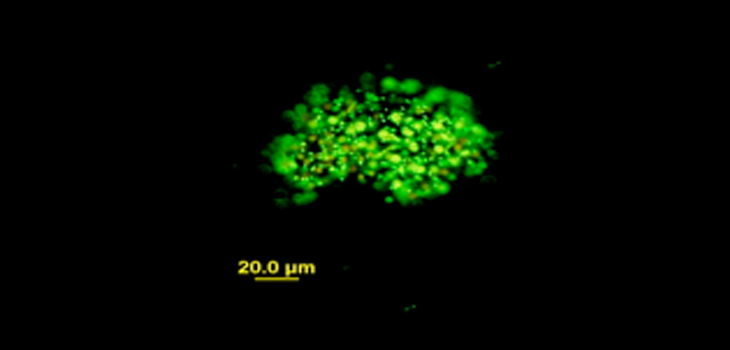
The dye is green and it sticks to bone fragments and grafts. When it is exposed to light the dye becomes antimicrobial.
Green Dye Kills Bacteria on Bone
2 min read Premium comments
Secondary
A study, published online in April in the journal of Clinical Orthopaedics and Related Research, reports that an antimicrobial dye activated by light “avidly adheres to bone to prevent bacteria from growing on bone fragments used in reconstructive surgery, and remove any bacteria that has already attached, thereby sterilizing the bone for surgery.”
Noreen Hickok, Ph.D, associate professor of orthopedic surgery at Thomas Jefferson University, Philadelphia, led the team that carried out the research. “We used a class of chemicals called porphyrins that are tolerated very well by the body in the dark and appear to have excellent antimicrobial properties in the presence of light. These properties allow sterilization during surgical procedures, which occur in bright light, ” she said.
Hickok explained that surgeons often use bone chips or bone powder as a sort of putty during bone reconstruction to help areas of bone re-grow. These bone materials are typically sterilized with a series of methods including various detergents and high pressure steam sterilization. But bacteria can still creep in once the material is handled again. “Bacteria really love to hide and grow in the nooks and crannies of porous bone and bone fragments—it’s one of the most perfect surfaces for bacterial growth, ” said Hickok.
The researchers took these bone chips, treated them with a green dye called TAPP (which stands for 5, 10, 15, 20-tetrakis-(4-aminophenyl)-porphyrin) and showed that in the dark, TAPP is stable. But when the lights go on, TAPP becomes active, producing chemicals called reactive oxygen species, or ROS, that rapidly kill the bacteria.
Hickok and colleagues first treated the bone putty with TAPP and then exposed those fragments to bacteria. As long as the lights were on, the bacteria were unable to attach and grow on the surface of the bone.
The researchers then showed that TAPP not only prevents bacterial growth, but can also breaks up bacterial slime, or biofilms, already growing on the bone fragments. They demonstrated this by first allowing bacteria to colonize the bone and then treating it with TAPP. They showed that the dye binds tightly to the bone, without any trace of leaching out into surrounding fluid, suggesting that it could be safe and non-toxic to normal tissue once implanted.
Author
React:
Discussion
This is a fascinating development. In my practice we've seen similar outcomes with the revised protocol. The key differentiator seems to be patient selection criteria. Has anyone else noticed the correlation with BMI thresholds?
Great point. I'd push back slightly on the conclusion, the sample size in the cited study is too small to draw population-level inferences. That said, the directional signal is compelling and worth a larger RCT.
We implemented a similar approach last year. Early results are promising but we're still gathering 12-month follow-up data. Happy to share our protocol if anyone is interested.
Join the conversation
Orthopedic professionals are discussing this. Sign in and upgrade to read every comment and add your voice.