
“When it comes to small canals, with cemented stems you get better outcome and survival, fewer dislocations, fewer periprosthetic fractures, less thigh pain, and fewer revisions!” argues Thorsten Gehrke. “Remember, ” says Hugh Cameron, “small stems are short, and eventually, lucency will develop. This means that the remaining distal fixation will be precarious. And with cement in small canals you are reaming heavily and most of the cancellous bone is removed, thus the bone-cement interlock is poor.”
Gehrke, Cameron Debate Use of Cement in Small Canals
6 min read Premium comments
Great Debates
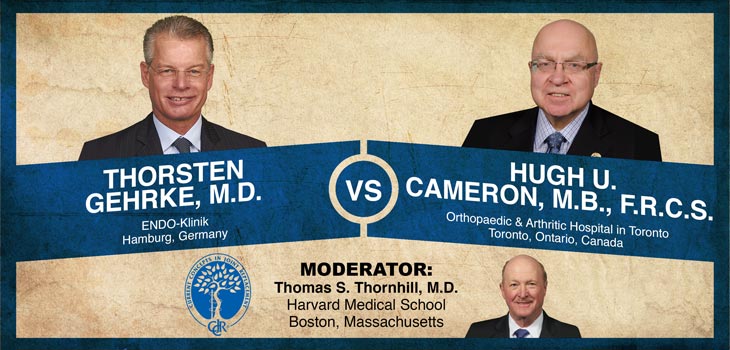
This week’s Orthopaedic Crossfire® debate was part of the 31st Annual CCJR – Winter meeting, which took place in Orlando this past December. This week’s topic is “Small Canals, Thick Cortices in Patients >60: The Cemented Solution.” For the proposition is Thorsten Gehrke, M.D. of ENDO-Klinik in Hamburg, Germany. Hugh U. Cameron, M.B., F.R.C.S. from Orthopaedic & Arthritic Hospital in Toronto is in opposition. Moderating is Thomas S. Thornhill, M.D. of Harvard Medical School.
Dr. Gehrke: “We usually mean Dorr Type A when we are talking about a small canal and thick cortical bone (according to Noble et al., ‘champagne flute.’)”
“There is a recently published study (Issa et al.) that compared the results of a cementless stem between Type A and Type B Dorr. They found that the aseptic survivorship was very similar, but what is the main concern if we’re talking about cementing in Type A? That we produce big implants and a very thin cement mantle. A 2011 paper by Chiu et al. looked at small femoral stems in patients with small femurs. If you use small femoral stems and you cement them then you will get very good results. They did report some subsidence (less than 2mm), but they were all clinically unapparent and the survival rate was very good.”
“To my knowledge, there is only one paper comparing the results of cemented and uncemented stems regarding the Dorr Types (Nash et al.). They recorded the intraoperative fracture and the postoperative dislocation rate within 30 days. Surprisingly, there were no intraoperative fractures in Dorr Type A. However, there was a lower rate of fractures in cemented versus uncemented stems. There was also a much lower rate of postoperative dislocation in cemented versus uncemented stems.”
“I continue to cement hips because it comes with better outcome and survival, fewer dislocations, fewer periprosthetic fractures, fewer intraoperative fractures, fewer leg length discrepancies, less thigh pain, fewer revisions…and more fun!”
“Regarding better outcomes, I already mentioned the uncemented paradox. As for dislocations, a paper by Crawford et al. involving nearly 60, 000 patients found a much higher dislocation rate in the uncemented cups. And a recently published paper by Thien et al. (440, 000 surgeries) found that the incidence of revision for periprosthetic fracture was 0.47% for uncemented stems and 0.07% for cemented stems. A 2008 study by Fernandez-Fernandez et al. found an 11% incidence of femoral fractures due to the use of uncemented total hip replacement.”
“As for leg length discrepancy, Ahmad et al. (2009) reported that in 56% of their uncemented stems there was a leg length discrepancy of >1cm; in the cemented stems there were only 23% who had such a discrepancy. Whittingham-Jones stated, ‘…the surgeon must appreciate the less forgiving nature of uncemented hip implants….”
“When it comes to hip pain, there is data from the last National Joint Registry of England, Wales and Northern Ireland showing that with the uncemented metal-poly the pain was twice as high. And regarding revisions, if you compare Sweden with the U.S., you see there is an 8% revision burden in Sweden; in the U.S. it is 18%.”
Dr. Cameron: “The simple answer is, ‘Don’t use cement with small canals.’ Or rather, ‘Use cement only if the patient’s life expectancy is very limited…because the stem survival will be limited.’ The patient’s age isn’t important, but the geometry is.”
“If you have a 9mm canal then you need a cement mantle of at least 2mm thick. That means that the maximum diameter of the stem is going to be 5mm, which will either break or cycle under load. Remember that small stems are short stems, and over time, lucency will develop in zones one and seven. This means that the remaining distal fixation will be very precarious…so short cemented stems will have a limited life expectancy.”
“Most small canals are in small people. However, some normal size people have huge cortical thickness with a correspondingly small canal. With cement in small canals you must ream heavily in order to get the cement in. Most of the cancellous bone is removed, thus the bone-cement interlock is poor.”
“Non-cemented stems in small canals can also be a problem. If the fixation is distal then the stem may be degraded by porous coating…and without good proximal fixation the stem will tend to cycle and may fracture in the midstem region. If you’re using a wedge shaped stem, the capacity to alter version is very limited in small canals. In CDH (congenital dislocation of the hip) cases you may have to accept a huge amount of anteversion, which leads to an ‘In Toe’ gait with frequent falls.”
“Let’s look at the 9mm stems where we actually have had some problems. The SROM proximally modular stem is a monoblock, so it’s not degraded with a coating and is thus at full strength. It is split distally so that if the femur bows early it can deform to give a 3 degree bend. And it is undersized proximally, so you insert it in any version. The stem is canal filling distally for angular control, and it is distally fluted for rotational control.”
“With the SROM proximally modular stem, the proximal sleeve can be inserted in any version to give maximal metaphyseal fill. The sleeve provides fixation, the stem is polished distally to give stability, not fixation. This then limits proximal stress shielding. Stems smaller than 9mm don’t need to be split because they would potentially be too weak.”
“I have my own 9mm stem results over 5-15 years with a mean follow-up of 15 years (patients with a variety of conditions). In a case done by my old chief Jim Bateman, all he could put in was a Neer shoulder prosthesis…then I revised it to a Baby Muller—the smallest cemented stem available. That was fine for about 9 years, then it came loose. Then I put in a 9mm SROM stem which is still going strong after 19 years.”
“So in a small canal use an ingrowth stem. The choice of stem is based on bone geometry and not on age. I do cemented stems in elderly people with big canals and big cortices (about 15%), but I have to say that I am an exception. In my hospital, very few hip stems are cemented. And I expect to see less in the future as the residents in North America are not being trained to cement.”
Moderator Thornhill: “Thorsten, which is harder to do…an uncemented femoral stem or a cemented femoral stem?”
Dr. Gehrke: “Cemented. If I have a 60-year-old patient with this kind of femur, I would use an uncemented stem (because of all of the media pressure, etc.). But nothing against cemented stems. If you have a thin canal then you must adjust your implant.”
Moderator Thornhill: “Hugh, same question.”
Dr. Cameron: “I think the cemented is much more difficult because you have to be trained to do it.”
Moderator Thornhill: “Thorsten, there was once the belief that a benefit of methacrylate is that it had a modulus of elasticity that spanned cortical and cancellous bone. Is that a myth?”
Dr. Gehrke: “I’m not sure that this is the main advantage. I think the main advantage is that you can control the positioning of the stem. This leads to fewer dislocations, etc.
Dr. Cameron: “Tom, I want to answer that. I think it’s important, but it’s much more important in the tibia than in the femur. If you put a solid stem down inside of a tibia you’re much more liable to get end of stem pain. It took me about 20 years to convince the companies that they should split that stem to make it more flexible.”
Moderator Thornhill: “Hugh, Thorsten said that in looking at the data that there was a higher incidence of dislocation in uncemented stems than in cemented stems. Do you agree? If so, is it a function of the fixation?”
Dr. Cameron: “It’s a function of the subject (perhaps patient would be a better word option). You go to the literature and it says the cement’s made of green cheese.”
Moderator Thornhill: “Thorsten, you don’t think it’s a function of fixation, do you?”
Dr. Gehrke: “Yes, because during the cementing process you have much more control over the positioning of your stem. I think that leads to a more pre-sized stem orientation…especially for the cups.”
Moderator Thornhill: “So not fixation, but positioning of the implant?”
Dr. Gehrke: “Yes.”
Moderator Thornhill: “Thank you, gentlemen.”
Please visit www.CCJR.com to register for the 2015 CCJR Spring Meeting, December 9 – 12 in Orlando.
Author
React:
Discussion
This is a fascinating development. In my practice we've seen similar outcomes with the revised protocol. The key differentiator seems to be patient selection criteria. Has anyone else noticed the correlation with BMI thresholds?
Great point. I'd push back slightly on the conclusion, the sample size in the cited study is too small to draw population-level inferences. That said, the directional signal is compelling and worth a larger RCT.
We implemented a similar approach last year. Early results are promising but we're still gathering 12-month follow-up data. Happy to share our protocol if anyone is interested.
Join the conversation
Orthopedic professionals are discussing this. Sign in and upgrade to read every comment and add your voice.