
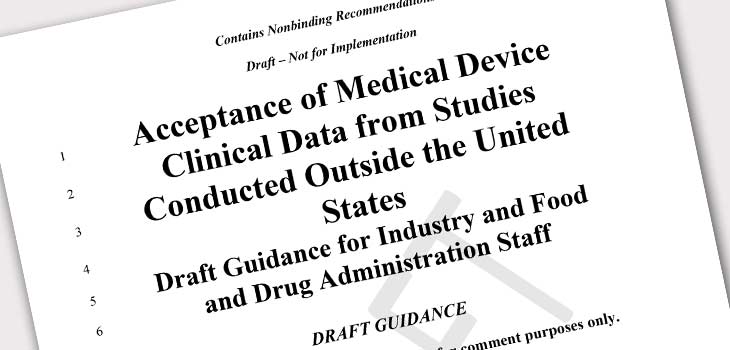
Medical device companies are increasingly conducting clinical studies outside the U.S. and then using the data in regulatory submissions to the FDA. On April 22, 2015, the FDA issued a draft guidance that lays out the factors the agency will consider when device makers submit the data from those foreign studies.
FDA Proposes Foreign Clinical Study Submission Guidelines
2 min read Premium comments
Secondary
The draft guidance does not announce new policy, but describes the FDA’s current approach to the topic. The agency wants your comments. You have until July 22, 2015 to comment.
The FDA has been accepting foreign studies in device submissions for a long time. But this draft guidance, according to the agency, “articulates FDA’s policy of accepting scientifically valid clinical data from foreign clinical studies in support of premarket submissions for devices.” The guidance describes:
- Special considerations that apply when using such data, including applicability of the data to intended patient populations within the U.S and study design issues, and
- Recommendations to assist sponsors in developing data that are adequate under applicable FDA standards to support approval or clearance of the device in the U.S.
The draft guidance builds on the goals that Congress established in 2012 with the Food and Drug Administration Safety and Innovation Act (FDASIA), which added section 569B to the Federal Food, Drug, and Cosmetic Act. In particular, section 569B, which is codified at 21 USC 360bbb-8b, requires FDA to accept data from foreign studies and to notify sponsors of its reasoning if it finds such data inadequate to support device approval or clearance.”
IDE, DeNovo and HDE Added
While clarifying that the agency will accept foreign data for premarket approval applications (PMA), premarket notifications (510k) it now adds investigational device exemption applications (IDEs), de novo petitions and humanitarian device exemptions. A large portion of the document talks about how the agency analyzes the foreign data. “As with data from U.S. clinical trials, FDA must determine whether data from a foreign study constitute ‘valid scientific evidence’ under 21 CFR 860.7.” In addition the document acknowledges “certain challenges exist in using data derived from foreign studies of devices.”
Submit Comments
You should submit comments and suggestions regarding this draft document within 90 days of publication in the Federal Register of the notice announcing the availability of the draft guidance. Submit electronic comments to: http://www.regulations.gov. Submit written comments to the Division of Dockets Management (HFA-305), Food and Drug Administration, 5630 Fishers Lane, rm. 1061, Rockville, MD 20852. Identify all comments with the docket number listed in the notice of availability that publishes in the Federal Register
Author
React:
Discussion
This is a fascinating development. In my practice we've seen similar outcomes with the revised protocol. The key differentiator seems to be patient selection criteria. Has anyone else noticed the correlation with BMI thresholds?
Great point. I'd push back slightly on the conclusion, the sample size in the cited study is too small to draw population-level inferences. That said, the directional signal is compelling and worth a larger RCT.
We implemented a similar approach last year. Early results are promising but we're still gathering 12-month follow-up data. Happy to share our protocol if anyone is interested.
Join the conversation
Orthopedic professionals are discussing this. Sign in and upgrade to read every comment and add your voice.