
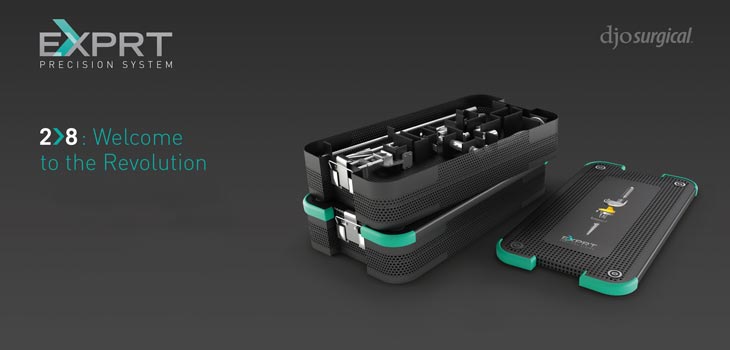
DJO Global, Inc. has recently launched the new Exprt Precision System, indicating that it is meant for highly proficient revision knee surgeons. “Streamline” is the word here, with a compact design that reduces turn times and minimizes waste. The bonus? It costs 40-70% of the cost of comparable knee revision systems.
DJO Launches Exprt Knee System
2 min read Premium comments
Secondary
The company worked alongside seasoned revision surgeons on this product, which contains a comprehensive 2-tray system that replaces the traditional 8-tray setup used during complex, total knee revisions. This, says the company, dramatically reduces prep time, eliminates unnecessary surgical steps, and allows the precision skills of revision surgeons to truly hit the mark. The system boasts built-in augments, single radius design, and e+ polyethylene.
“The Exprt approach leads to efficient operations that save both time and money, while providing excellent early results, ” said C. Lowry Barnes, M.D., chairman of orthopaedics at University of Arkansas for Medical Sciences.
“My operating team especially appreciates the fact that only two pans of instruments are opened. I believe that I can speak for the entire Exprt design team when I say that we have met our goals in offering a high-value, high-quality revision knee system for the accomplished surgeon.”
“In today’s value driven health care environment, cost effectiveness is crucial in order to provide stakeholders with a high-quality result at a reasonable cost, ” said Dr. Richard Iorio, chief of Adult Reconstructive Surgery at NYU Langone Medical Center. “Putting the patient ahead of profits, the Exprt System allows skilled surgeons to provide TKA patients with a functional knee at a fraction of traditional costs.”
DJO Global CEO Mike Mogul told OTW, “One of the most gratifying milestones during the development of the Exprt Precision System occurred during one of our first evaluation labs as we watched the design panel of highly skilled surgeons throw out instrument after instrument and remove the bells and whistles off the pieces that remained, resulting in the Exprt’s 2-tray system versus the traditional 8-tray setup. At that moment, it became clear that the massive sets of complex instruments the industry has spent the last 20 years developing to make revision knee surgery more efficient, actually has had the opposite effect for the more experienced revision surgeon.”
Author
React:
Discussion
This is a fascinating development. In my practice we've seen similar outcomes with the revised protocol. The key differentiator seems to be patient selection criteria. Has anyone else noticed the correlation with BMI thresholds?
Great point. I'd push back slightly on the conclusion, the sample size in the cited study is too small to draw population-level inferences. That said, the directional signal is compelling and worth a larger RCT.
We implemented a similar approach last year. Early results are promising but we're still gathering 12-month follow-up data. Happy to share our protocol if anyone is interested.
Join the conversation
Orthopedic professionals are discussing this. Sign in and upgrade to read every comment and add your voice.