
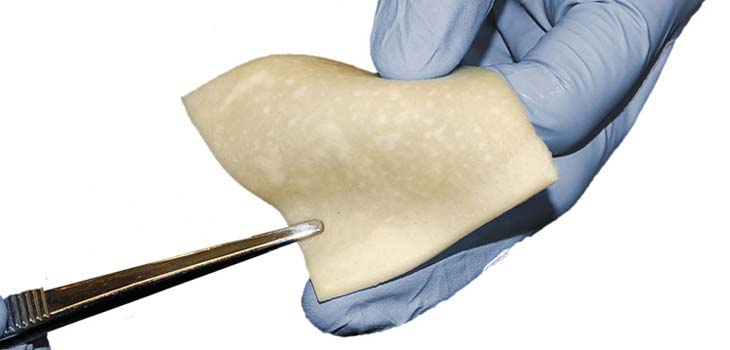
Bacterin International Holdings, Inc.’s Acellular Dermal Matrix allograft (ADM), hMatrix, has received coverage from Novitas Solutions, Inc. (Novitas).
Bacterin Allograft Gets Coverage for 11.3 Million Medicare Beneficiaries
1 min read Premium comments
Secondary
Novitas is one of eight Medicare Administrative Contractors (MACs) “that are responsible for processing Medicare claims in one or more of 12 geographic areas or “jurisdictions” in the U.S. In addition to processing claims, each MAC is also responsible for issuing local coverage determinations (LCDs) that specify which health care products and services are reimbursable through the Medicare Fee-for-Service program in the regions under its jurisdiction.”
Novitas is responsible for approximately 11.3 million Medicare beneficiaries within its jurisdictions.
Local Coverage Determination
On April 10, 2015, Novitas “published a local coverage determination titled Application of Bioengineered Skin Substitutes to Lower Extremity Chronic Non-Healing Wounds (L27549), which included Bacterin’s ADM product. Novitas has jurisdiction in two geographic areas, including 11 states and the District of Columbia. This LCD was effective for services performed on or after April 9, 2015.”
Deep Wound Treatment
Treatment of deep wounds often requires a dermoconductive graft material to facilitate formation of granulation tissue and aid in wound closure. Allograft-derived acellular dermis are one such graft. The company says “acellular dermal matrices are used as a primary grafting material that can replace damaged or inadequate dermal tissue while helping to reduce the size of the wound and providing protection to the site of injury.”
hMatrix ADM
hMatrix is an allograft derived from donated human skin. According to the company, “the dermis is processed using a proprietary method to remove the cells in order to maximize graft incorporation. The natural collagen and elastin matrix is ideal for neovascularization and cellular proliferation and has the potential to expedite the healing process. hMatrix ADM is provided as a sterile product with a device-level (SAL) of 10-6.”
The allograft is “indicated for homologous use only. Specific uses of hMatrix include use as a wound covering, abdominal wall repair, breast reconstruction, and for use in supplemental support, reinforcement, or covering of tendons or periosteum.”
Author
React:
Discussion
This is a fascinating development. In my practice we've seen similar outcomes with the revised protocol. The key differentiator seems to be patient selection criteria. Has anyone else noticed the correlation with BMI thresholds?
Great point. I'd push back slightly on the conclusion, the sample size in the cited study is too small to draw population-level inferences. That said, the directional signal is compelling and worth a larger RCT.
We implemented a similar approach last year. Early results are promising but we're still gathering 12-month follow-up data. Happy to share our protocol if anyone is interested.
Join the conversation
Orthopedic professionals are discussing this. Sign in and upgrade to read every comment and add your voice.