
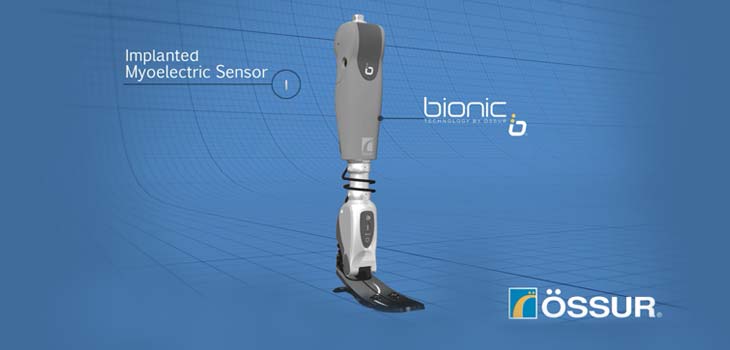
Smart phones…nice! Smart limbs…phenomenal! Thanks to the foresight of those at the Icelandic company Össur, today there are two amputees—the first people in the world—who can control their bionic prosthetic legs with their thoughts. The prosthesis works via implanted myoelectric sensors (IMES) that have been surgically placed in their residual muscle tissue. The IMES, which was provided by the Alfred Mann Foundation, instantaneously triggers the desired movement, via a receiver located inside the prosthesis. This process occurs subconsciously, continuously and in real-time. The bionic limbs are capable of real-time learning and automatically adjusting to their user’s gait, speed and terrain.
Amputees Controlling Bionic Legs With Their Thoughts
1 min read Premium comments
Secondary
According to the May 20, 2015 news release, Thorvaldur Ingvarsson, M.D., Ph.D. is the orthopedic surgeon who leads Össur’s research and development efforts and spearheaded the mind-controlled prosthetics project. He noted that, “movement in able-bodied individuals generally begins subconsciously, which triggers electrical impulses inside the body that catalyze the appropriate muscles into action. Össur’s new technology replicates that process in an amputee: that electronic impulse from the brain is received by an IMES that was surgically placed by Dr. Ingvarsson into muscles in the amputee’s residual limb.”
“The technology allows the user’s experience with their prosthesis to become more intuitive and integrative, ” Dr. Ingvarsson said. “The result is the instantaneous physical movement of the prosthesis however the amputee intended. They no longer need to think about their movements because their unconscious reflexes are automatically converted into myoelectric impulses that control their bionic prosthesis.”
The two amputees have been living with Össur’s mind-controlled bionic prostheses for more than one year. Dr. Ingvarsson notes that feedback from both users has been very positive, and that clinical trials to further assess the technology will continue.
Asked about the challenges involved in placing the sensor in the patient’s residual muscle tissue, Dr. Ingvarsson told OTW, “The challenge is the precise location of the sensors; otherwise, it is a minimally invasive and relatively straightforward surgery for any orthopaedic surgeon.’
As for what patients say, he added, “The patients reported that the main challenge was in fact emotional, in a positive way.”
Author
React:
Discussion
This is a fascinating development. In my practice we've seen similar outcomes with the revised protocol. The key differentiator seems to be patient selection criteria. Has anyone else noticed the correlation with BMI thresholds?
Great point. I'd push back slightly on the conclusion, the sample size in the cited study is too small to draw population-level inferences. That said, the directional signal is compelling and worth a larger RCT.
We implemented a similar approach last year. Early results are promising but we're still gathering 12-month follow-up data. Happy to share our protocol if anyone is interested.
Join the conversation
Orthopedic professionals are discussing this. Sign in and upgrade to read every comment and add your voice.