
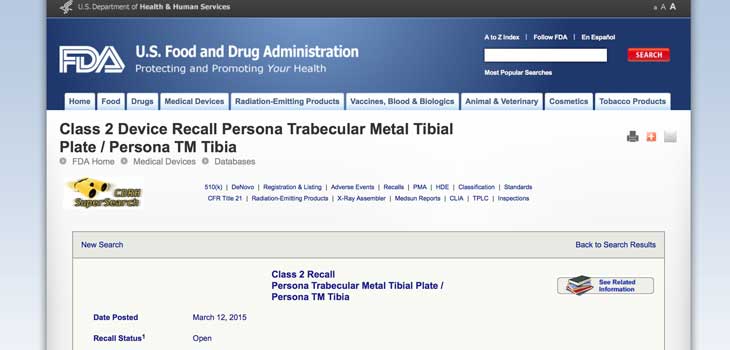
Zimmer Holdings Inc. has recalled 11, 658 parts used in its Persona Trabecular Metal Tibial Plate/Persona TM Tibia knee implant systems.
Zimmer Recalls 11, 658 Persona Knee Parts
1 min read Premium comments
Secondary
According to the Food and Drug Administration (FDA), Zimmer is initiating the voluntary global recall following an increase in complaints of “radiolucent lines and loosening.” All sizes and lots of the affected devices are being removed from distribution. In the U.S., the part was distributed to a number of VA Medical Centers in states including South Dakota, Georgia, Alabama, Massachusetts, New York, Ohio, Indiana, Pennsylvania, Missouri and California.
It’s a Class II recall, which means the FDA believes the product can “cause temporary or medically reversible adverse health consequences.”
Problems associated with this implant can cause serious complications and patients can face the risk of loosening of their tibial component. Indications of loosening include radiolucent lines on imaging tests, which are large gaps between the device and bone. Loosening can cause pain and significant mobility problems, and can require the patient to undergo additional surgery to remove and replace the loose tibial component.
Urgent Medical Device Recall notices were issued to affected distributors, hospitals, and surgeons on February 16, 2015 via mail. Customers were asked to review the notification and ensure affected personnel are aware of the contents. All affected product are to be located and quarantined immediately. The Inventory Return Certification Form should be completed and returned along with the recalled product. Customers may contact the following with any questions: 1-877-946-2761 between 8:00 am and 5:00pm EST.
The FDA Notice can be read here:
Introduced in 2013
Zimmer introduced, “Persona – The Personalized Knee System”, at the 2013 American Academy of Orthopaedic Surgeons annual meeting. The company said the new system “ushers in a new era in total knee replacement, combining personalized implants with intelligent instrumentation to provide surgeons with a new level of intraoperative precision to customize the best fit for their patients.
Author
React:
Discussion
This is a fascinating development. In my practice we've seen similar outcomes with the revised protocol. The key differentiator seems to be patient selection criteria. Has anyone else noticed the correlation with BMI thresholds?
Great point. I'd push back slightly on the conclusion, the sample size in the cited study is too small to draw population-level inferences. That said, the directional signal is compelling and worth a larger RCT.
We implemented a similar approach last year. Early results are promising but we're still gathering 12-month follow-up data. Happy to share our protocol if anyone is interested.
Join the conversation
Orthopedic professionals are discussing this. Sign in and upgrade to read every comment and add your voice.