
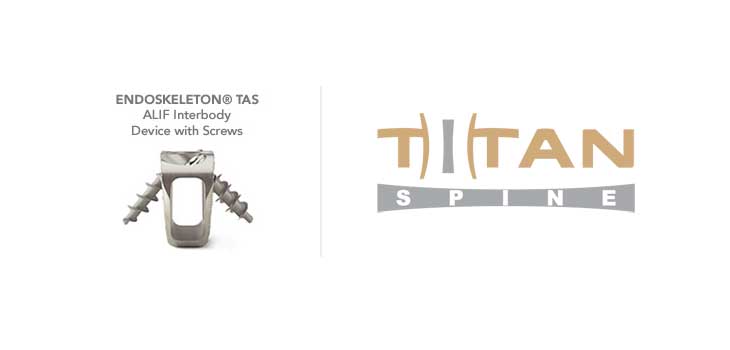
Titan Spine, LLC has announced that data from a study comparing its proprietary surface technology to polyetheretherketone (PEEK) have now been published in the March 15 print issue of Spine. According to the April 6, 2015 news release, the study found that “Titan’s Endoskeleton Interbody Devices promote osteoblastic differentiation and enhanced bone-forming environment compared to devices made from PEEK. Specifically, the data show that fibrous tissue formation around PEEK implants may be due to the creation of an inflammatory environment.” The study was honored with the 2014 Whitecloud Award for Best Basic Science Research from the Scoliosis Research Society.
Titan Spine: Our Interbody Devices Trump PEEK Devices
2 min read Premium comments
Secondary
Barbara Boyan, Ph.D., Dean of the School of Engineering at Virginia Commonwealth University, and lead author of the study said, “These results indicate that Titan’s surface reduces production of inflammatory mediators and increases production of anti-inflammatory mediators compared to PEEK, thus creating an enhanced environment for bone growth and fusion. Fibrous tissue formation around PEEK spinal implants is due to several factors including increased inflammatory cytokines and decreased cell viability. These data add to the growing body of medical knowledge supporting the use of titanium implants featuring a complex roughened topography at the macro-micro-nano (MMN) levels that induce healing on the cellular level where it is critical for early bone formation.”
Titan Spine CEO Peter Ullrich, M.D., a former surgeon, commented, “This study is yet another example in a rapidly growing body of evidence that PEEK is a poor material for promoting bone growth. Until recently, PEEK was thought to be inert at best. We now understand that is not the case. Dr. Boyan’s research demonstrates that PEEK is actually inhibitory to bone forming cells, called osteoblasts, through the upregulation of pro-inflammatory markers. This leads to fibrous tissue formation, rather than bone formation, as the body attempts to protect itself from PEEK through encapsulation. We were pleased when the IMAST [International Meeting on Advanced Spine Techniques] program committee recognized the importance of these data by granting it with the Whitecloud Award. Titan will continue to be at the forefront of scientifically engineering superior interbody fusion devices and promoting titanium as the preferred material for bone growth and fusion.”
Dr. Boyan told OTW, “We were most surprised to learn that growth on the PEEK surface caused mesenchymal stem cells to produce such a different set of inflammatory factors and factors associated with cell death when compared to cells that were grown on the titanium alloy surfaces. We had expected cells on the rough Ti6Al4V surface to perform better than cells on the smooth surface, and that proved to be the case.”
“It is important for orthopaedic surgeons to realize that this is a cell culture study and the overall health of their patient will have an impact on the success of the implant as well. However, these data do suggest that the fibrous connective tissue interface that occurs with PEEK implants may result from an inflammatory local environment.”
React:
Discussion
This is a fascinating development. In my practice we've seen similar outcomes with the revised protocol. The key differentiator seems to be patient selection criteria. Has anyone else noticed the correlation with BMI thresholds?
Great point. I'd push back slightly on the conclusion, the sample size in the cited study is too small to draw population-level inferences. That said, the directional signal is compelling and worth a larger RCT.
We implemented a similar approach last year. Early results are promising but we're still gathering 12-month follow-up data. Happy to share our protocol if anyone is interested.
Join the conversation
Orthopedic professionals are discussing this. Sign in and upgrade to read every comment and add your voice.