
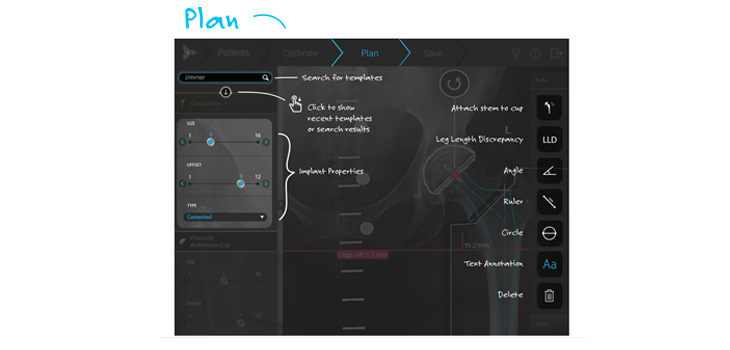
Brainlab, a 25-year-old medical technology company from Munich, Germany, exhibited at the American Academy of Orthopaedic Surgeons (AAOS) Las Vegas convention what it claims to be the first digital app for an iPad that enables surgeons to do automatic, pre-operative joint replacement planning off site. Called the TraumaCad Mobile, the app contains images of 20, 000 possible implants and automatically aligns implants to their anatomic landmarks.
Plan Surgery at Home on iPad App
1 min read Premium comments
Secondary
Company officials point out that their app saves time both in the pre-planning of the surgery and in the operating theater. The app is designed to assemble components at their attachment points, to calculate the resulting leg length of the patient when the surgery is completed and determine the offset of the implant. According to a company spokesman, the app is compatible with the GACS systems used by many hospitals.
Brainlab has been privately held since its formation in 1989. The company develops medical technology for image-based surgery. It is primarily focused on medical software. It presently has more than 5, 000 systems installed in 95 countries and employs 1, 150 people in 17 offices worldwide.
Author
React:
Discussion
This is a fascinating development. In my practice we've seen similar outcomes with the revised protocol. The key differentiator seems to be patient selection criteria. Has anyone else noticed the correlation with BMI thresholds?
Great point. I'd push back slightly on the conclusion, the sample size in the cited study is too small to draw population-level inferences. That said, the directional signal is compelling and worth a larger RCT.
We implemented a similar approach last year. Early results are promising but we're still gathering 12-month follow-up data. Happy to share our protocol if anyone is interested.
Join the conversation
Orthopedic professionals are discussing this. Sign in and upgrade to read every comment and add your voice.