
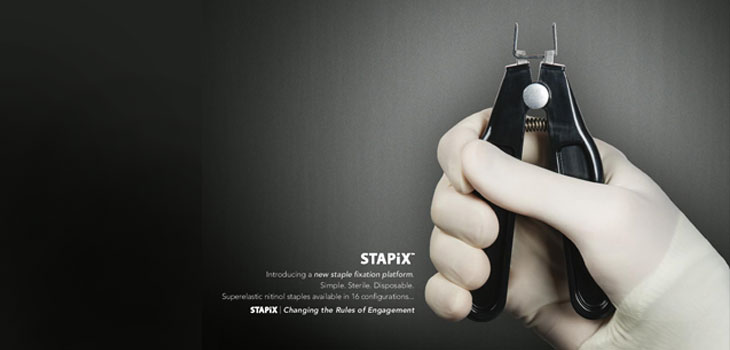
By launching the STAPix Superelastic Nitinol Staple Fixation System, Houston-based Instratek claims to be the first company to offer a “fully functional” sterile staple inserter.
New Staple Inserter Makes “Most Advanced” Claim
1 min read Premium comments
Secondary
In an April 9, 2015 press release, the company says the system is the “most advanced” device of its kind and enables extremity surgeons to “confidently control” staple arm width during insertion, removal, and repositioning if necessary.
The kits are sterile, single-use, and fully disposable. The system, according to the company, has numerous sizing options giving the surgeon flexibility in the forefoot, midfoot, hindfoot, and hand. “Our comprehensive kit configurations contain all the necessary components for a successful procedure including: implant, drill guide, drill bit, locating pins, inserter tool, and tamp, ” stated the press release.
The device is intended for orthopedic and podiatry surgery and is now available in the U.S. through the company’s distributor-based sales force.
Instratek’s other products include the Jones-FX, Mini Cannulated Titanium Headed & Headless Screw System, CMC Cable FIX, Endotrac-Endoscopic Carpal Tunnel Release System, Endoscopic Trigger Finger Release, Endoscopic Plantar Fasciotomy, Endoscopic Gastrocnemius Release, Endoscopic Decompression of the Intermetarsal Nerve, MABS (Michelanglo Bunion System), and Sub-Talar Lok arthroereisis implant.
The company has been making endoscopy and implants for the extremity market for 23 years. It changed ownership in June 2014 when its former president, Jeff Seavy bought the company. He began working for Instratek Incorporated, as the company was then known, in 2007.
Author
React:
Discussion
This is a fascinating development. In my practice we've seen similar outcomes with the revised protocol. The key differentiator seems to be patient selection criteria. Has anyone else noticed the correlation with BMI thresholds?
Great point. I'd push back slightly on the conclusion, the sample size in the cited study is too small to draw population-level inferences. That said, the directional signal is compelling and worth a larger RCT.
We implemented a similar approach last year. Early results are promising but we're still gathering 12-month follow-up data. Happy to share our protocol if anyone is interested.
Join the conversation
Orthopedic professionals are discussing this. Sign in and upgrade to read every comment and add your voice.