
“With superior capsulotomy there is no fluoro or X-ray required, there is more accurate component placement, and it’s extensile, ” argues Stephen Murphy. “And there is a 23% lower cost over 90 days.” Jose Rodriguez counters, “The major reason why this hasn’t spread is that you have to buy into navigation. Then there is technical ability; it’s a very different technique. It’s quirky, and you lose tactile feedback.”
Murphy, Rodriguez Debate Superior Capsulotomy
7 min read Premium comments
Great Debates
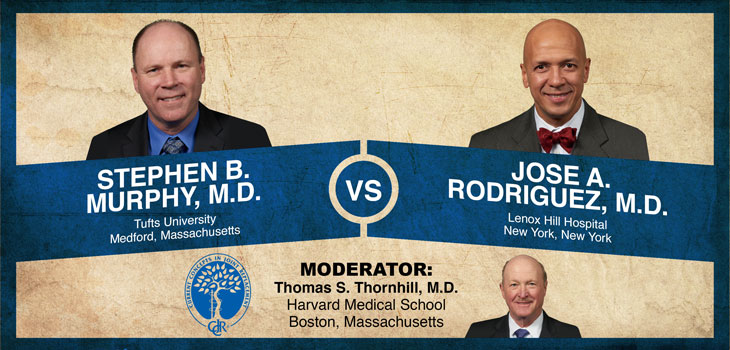
This week’s Orthopaedic Crossfire® debate was part of the 31st Annual CCJR – Winter meeting, which took place in Orlando this past December. This week’s topic is “Superior Capsulotomy: The Ideal Approach for THA.” For the proposition is Stephen B. Murphy, M.D. of Tufts University. Jose A. Rodriguez, M.D. of Lenox Hill Hospital in New York is in opposition. Moderating is Thomas S. Thornhill, M.D., Harvard Medical School.
Dr. Murphy: “In 2002 when we were developing this there were a few principles that we were trying to adhere to: Do the hip surgery without having to dislocate the hip; preserve the abductors, short rotators, and posterior capsule; be able to transition this into a traditional exposure if necessary; be able to perform a trial reduction; eliminate the need for intraoperative fluoro or radiography; be able to use a standard OR table; be able to do it in the vast majority of patients; and allow unrestricted progression of activity.”
“With superior capsulotomy the patient is in a lateral position and the incision is a little proximal to the tip of the greater trochanter. The fascia is incised and bluntly spread. The back of the medius is identified and brought forward. The front of the piriformus is identified. This is the only structure that is incised. You can preserve it if you want, or repair it if you take it. Then the mimius is brought anteriorly to expose the superior hip joint capsule. A superior incision is made in the capsule and then turned a bit anteriorly. Then we place leverage retractors inside the capsule around the front and the back of the femoral neck.”
“The femur is entered with the head in situ, and then we open the top of the neck with an osteotome to allow for preparation of the femur. We then leave a broach in to use as an internal neck cutting guide, and a saw is used to transect the neck. Then the head is levered, a Shans pin is placed, and then the head is removed. Then we place retractors front/back and anterior/superior, use an angled reamer, and a double angled cup impactor to place the cup…trial reduction. At this point I go to the front of the table, put a bone hook in the trial, and control the leg with my other arm. I then assemble the head onto the neck in situ. The hip should be fully stable in all positions. Once you confirm that, you put the liner and real stem in, and assemble in situ and close the capsule.This can also be done with straight instruments using a longer incision or a percutaneous portal.”
“In 2006 we published that we had faster recovery and lower complications than with the transgluteal exposure I was using before. We’ve gotten to the point where almost 100% of primary hips can be done using this technique so that they’re not selected in any way. And it’s possible to use it in complex cases; in fact, dysplastic cases are a bit easier from this direction.”
“Our complication rates reveal 0 deep infections and only 3 dislocations in almost 2, 000 patients, despite the fact that we typically use relatively small bearings. Nerve injury is incredibly rare and usually resolves completely. And there were only two revisions for periprosthetic fracture.”
“Virtually every major complication has a lower incidence with this technique as compared to the anterior technique. In terms of cup position, if you look at anterior versus superior, Jose Rodriguez recently published that they had a 25% malposition rate with anterior exposures with fluoro. And there are several publications showing that we can easily get 98-100% if we use smart mechanical navigation in addition to the surgical technique.”
“Regarding length of stay, at our hospital the superior technique has a statistically significant shorter length of stay by almost a whole day…despite the fact that these are unselected cases…whereas the anterior are selected cases. The only outpatients that we’ve done at our hospital to date are those with whom we’ve used the superior technique. Concerning cost, there is recent Medicare data showing that it’s $5, 100 less per case over a 90 day period (compared to all other hips from our database).”
“There are many positives, including that it’s a safe operation that doesn’t require intraoperative imaging or a special table…and you get much more accurate component placement. When it comes to total hip arthroplasty, anterior is not superior.”
Dr. Rodriguez: “Merriam-Webster describes ideal as ‘exactly right for every purpose, situation, or person.’ Dictionary.com says it is, ‘conceived as constituting a standard of perfection or excellence; existing only in the imagination.’”
“An approach should be easy and safe. You should be able to get consistent, high quality outcomes, and it should be reproducible/transferable. Stephen and I agree that this technique is tissue-preserving; there is no posterior capsule cut, no actual dislocation, and the femur is prepared in situ.”
“In his published work, Stephen has shown that in early recovery patient outcomes are better compared to his transgluteal approach. He diminishes his abduction outliers, improves early recovery…and most importantly, in this transition his complication rate is less. There are fewer issues with greater trochanteric fracture because he’s not taking the wafer off the trochanter. And Stephen developed a technique for creating precision leg length in terms of operating. The difference between what he thought he got with navigation and what he actually achieved was less than a millimeter on average.”
“How does this technique compare to the industry standard? If we look just at the things happening at the New England Baptist, there is a significant difference in this cohort compared to the others in terms of length of stay (1.7 days for superior capsulotomy; 3.2 days for all others).”
“As for transferability/reproducibility, there are numerous good surgeons on the MicroPort website who are using this technique. I know most of these guys and they are really good surgeons. But they are still just out of the innovators and into the early adopters phase.”
“Why is this not more widely adopted? First, it’s not well marketed. If you Google ‘superior capsulotomy’ you get seven pictures. Effective marketing is one where that message is picked up by other venues and spread independently. Also, this is a multistep adoption process. It’s a very different technique, and it’s quirky; and you lose tactile feedback. To quote Stephen, he uses ‘funny looking instruments’ that go in differently. And broaching the femur in situ is very different.”
“I think the major reason why this hasn’t spread is that you have to buy into navigation because that’s the technique he has developed to create reproducibility. Then there is technical ability. I measure transferability by how frequently a resident who leaves an institution adopts that technique.”
Moderator Thornhill: “How many in the audience would use a superior capsulotomy approach or one of the other piriformus approaches? OK…I think I can count those. Steve, why is no one doing this?”
Dr. Murphy: “With the anterior exposure it’s a good technique, not great, though. Going supine with a fluoro on a fracture table is dramatically more different than switching to a superior capsulotomy from a posterior exposure (which you can transition in and out of). And the anterior exposure is not extensile. When we were developing these techniques we had to create the instruments. It’s different if you have a technique that is supported by a multi billion dollar company. People learning THIS technique are taking time out of their practices.”
Moderator Thornhill: “Jose, your approach?”
Dr. Rodriguez: “I use the direct anterior approach (DAA) for about 95% of my cases; no navigation.”
Moderator Thornhill: “Why do you think Steve’s approach hasn’t caught on more?”
Dr. Rodriguez: “Because you do need navigation, and that’s a hard thing to buy into.”
Moderator Thornhill: “Steve, why do you think the DAA has become so popular?”
Dr. Murphy: “I think it has to do with educational resources and industry support. Just in the past couple of years not only are there a lot of people using the instruments that I made years ago, but there are people calling it the northern exposure, the transpiriformus exposure, the direct superior exposure, etc. There are a million operations out there copying this and calling it different things, but they are based on the same principle. In the next couple of years there will be significant adoption of these techniques because they are better.”
Moderator Thornhill: “Jose, what is your average length of stay for a DAA total hip?”
Dr. Rodriguez: “Anyone 60 and under tends to go home the next day. As you get into the 70s they tend to stay three days so they can go to rehab.”
Moderator Thornhill: “David Lewallen has made a good point about letting people go with no crutches or anything and they go out and play tennis…it’s almost like a badge of courage. We may be going overboard and trying to discharge people before they’re admitted.”
Dr. Murphy: “In the anterior, if you’re cherry picking the cases then it’s like hip resurfacing. Obviously the patients do better—even though it’s a bigger operation—because you’re operating on better patients. In this situation I’m not focused on length of stay…patients just feel better and they want to make their way to the door. And, we have $0 in readmission with this operation in the last 12 months of the Medicare database.”
Dr. Rodriguez: “We’ve studied length of stay and found no difference between anterior and posterior patients…they were both diminishing. However, I insist that my patients use two crutches for two weeks because they will heal faster.
Moderator Thonrhill: “Thank you, gentlemen.”
Please visit www.CCJR.com to register for the 2015 CCJR Spring Meeting, May 17 – 20 in Las Vegas.
Author
React:
Discussion
This is a fascinating development. In my practice we've seen similar outcomes with the revised protocol. The key differentiator seems to be patient selection criteria. Has anyone else noticed the correlation with BMI thresholds?
Great point. I'd push back slightly on the conclusion, the sample size in the cited study is too small to draw population-level inferences. That said, the directional signal is compelling and worth a larger RCT.
We implemented a similar approach last year. Early results are promising but we're still gathering 12-month follow-up data. Happy to share our protocol if anyone is interested.
Join the conversation
Orthopedic professionals are discussing this. Sign in and upgrade to read every comment and add your voice.