
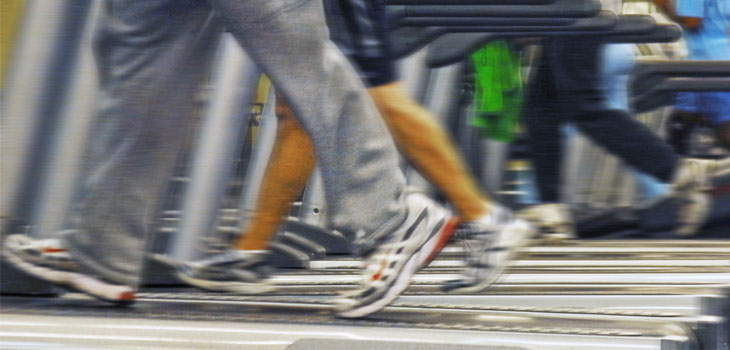
With running tracks blanketed under feet of snow in much of the country, runners are asking if running on a treadmill might be a good substitute for outdoor training. Exercise physiologist Reed Ferber, director of the running injury clinic at the University of Calgary in Canada, told Liz Neporent of Good Morning America that, for the average runner, the difference between them “doesn’t mean much.”
Treadmill OK Sub for Outdoor Running
1 min read Premium comments
Secondary
“You have more forward lean from your trunk and more flexion at the hips and knees when you run on a treadmill because you don’t need to generate as much power at the same speed as you do running on level ground outdoors.” he said. According to Neporent, studies show that there are tiny differences in the amount of calories burned while a subject is running at the same speed and incline on a treadmill as compared to running outdoors.
No one has yet looked at the types of injuries a runner may experience on a treadmill versus running outdoors. Ferber cautions runners who spend their winters on the treadmill to cut their mileage in half when they finally get back out on the road.
The reason, he explained, is that when runners run outdoors, their calf muscles produce about 80% of the forward propulsion power. This drops significantly when a runner is on a treadmill because the ground moves underneath the runner. “When you transition from the treadmill to the road, you could be at risk for calf strains, plantar fasciitis and Achilles tendonitis, ” he said.
Author
React:
Discussion
This is a fascinating development. In my practice we've seen similar outcomes with the revised protocol. The key differentiator seems to be patient selection criteria. Has anyone else noticed the correlation with BMI thresholds?
Great point. I'd push back slightly on the conclusion, the sample size in the cited study is too small to draw population-level inferences. That said, the directional signal is compelling and worth a larger RCT.
We implemented a similar approach last year. Early results are promising but we're still gathering 12-month follow-up data. Happy to share our protocol if anyone is interested.
Join the conversation
Orthopedic professionals are discussing this. Sign in and upgrade to read every comment and add your voice.