
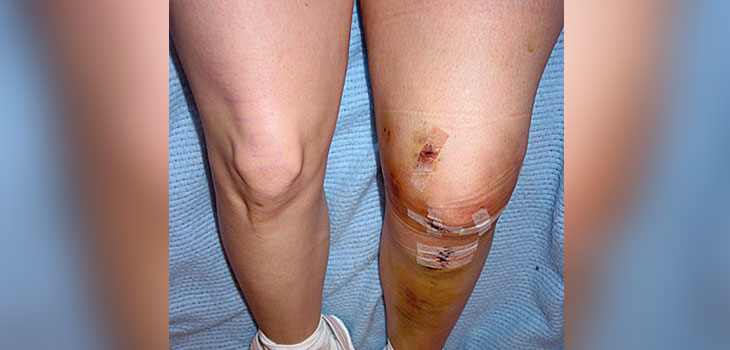
If you are a young athlete who had anterior cruciate ligament reconstruction (ACLR) you have a 33% chance of getting osteoarthritis of the knee within a year. That is the result of a study conducted by Adam Culvenor of the University of Queensland School of Health and Rehabilitation Sciences in Brisbane, Australia. The study was published in Arthritis & Rheumatology.
Prior ACLR Related To Knee Osteoarthritis
1 min read Premium comments
Secondary
According to MedPage Today, which reported on the study, 21 patients or 19% of 111 participants who had undergone ACLR a year earlier met the MRI criteria for tibiofemoral OA. Another 19 patients or 17% met the MRI criteria for patellofemoral OA. Put together, this means that 31% of the participants had MRI-defined knee OA one year after undergoing an ACLR. Among the uninjured controls, not one participant had MRI-defined patellofemoral or tibiofemoral OA.
Doctors detected bone marrow lesions (BMLs) in the femoral trochlea region in 19% of participants; they found cartilage lesions in 31% of participants and osteophytes in 37% of participants. Pathology in the patellofemoral joint on MRI included not only early features of OA such as BMLs and partial-thickness cartilage loss but osteophytes as well. The study subjects ranged in age from 18 to 50 years at the time of surgery. Their mean age was 30. The cause of all but three of the ACL injuries was participation in sports.
The investigators expressed hope that early detection of knee OA after an ACLR may permit early intervention such as load management which, they suggested, is likely to be more effective prior to the development of advanced disease.
Author
React:
Discussion
This is a fascinating development. In my practice we've seen similar outcomes with the revised protocol. The key differentiator seems to be patient selection criteria. Has anyone else noticed the correlation with BMI thresholds?
Great point. I'd push back slightly on the conclusion, the sample size in the cited study is too small to draw population-level inferences. That said, the directional signal is compelling and worth a larger RCT.
We implemented a similar approach last year. Early results are promising but we're still gathering 12-month follow-up data. Happy to share our protocol if anyone is interested.
Join the conversation
Orthopedic professionals are discussing this. Sign in and upgrade to read every comment and add your voice.