
“Ceramic-ceramic is a good option for the young, active patient. It is wear resistant, has improved lubrication, and allows thin inserts for large heads, ” argues Carsten Perka. “Ceramic has long been on a steady decline, ” says Robert Barrack. “There are malposition issues (leading to impingement and potential for failure), liner breakage and mal-seating and squeaking. Why pay more for something that is not improved?
Perka Debates Barrack Over Ceramic on Ceramic Hip
7 min read Premium comments
Great Debates
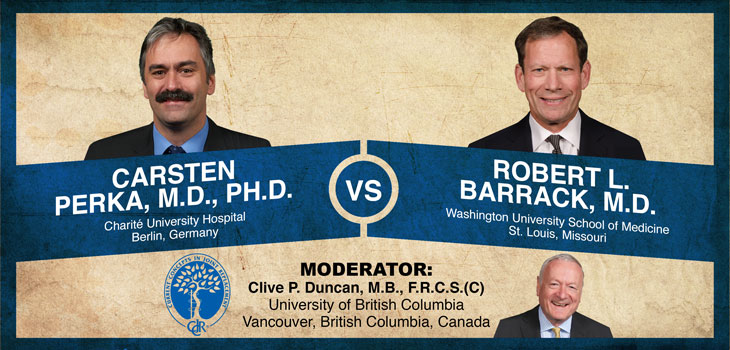
This week’s Orthopaedic Crossfire® debate was part of the 31st Annual CCJR — Winter meeting, which took place in Orlando this past December and is “Ceramic on Ceramic Hip Arthroplasty: A New Standard.” For the proposition is Carsten Perka, M.D., Ph.D. of Charité University Hospital in Berlin, Germany. Robert L. Barrack, M.D. of Washington University School of Medicine in St. Louis is in opposition. Moderating is Clive P. Duncan, M.B., F.R.C.S.(C) of the University of British Columbia.
Dr. Perka: “The issue is that patients are more active and they are living longer. The registries show that the revision rate is up to 35% in younger patients at 13 to 15 years. This is because of aseptic loosening. The major reasons for revision hip arthroplasty are wear and osteolysis; this has stimulated interest in alternative bearings. The new polys are good, and appear to be a significant improvement…but they are not perfect. We have smaller, but more reactive particles; we are on our third generation in 10 years; there are free radicals, lipid absorption, and material degradation on the second generation after 5-7 years. And there are different failure modes, such as rim failure, scratching, abrasion, creep, surface damage, and impingement.”
“In a 2014 poster presented at AAOS [American Academy of Orthopaedic Surgons] the researcher (Rowell) revealed that 12 out of 13 implants showed oxidation. Yes, volumetric wear is low, but this is only true for the 28-32mm heads. If you look at 36mm heads you see that in many cases the mean volumetric wear is above the limit where osteolysis occurs. We need other solutions.”
“The criteria for an excellent bearing are low wear, optimal material properties of the surface, excellent clinical results, and robustness. Papers by Kurtz (2011) and Parvizi (2012) show that ceramic-ceramic has the lowest wear rate of all bearings. In addition, you must have optimal material properties. Ceramic-ceramic has excellent chemical stability, superior lubrication, excellent biocompatibility, it is scratch resistant, and it’s a well proven technology (more than 10 million implantations). And what is increasingly important is that bigger heads don’t increase the wear rate.”
“Regarding long term survival, a study by Petsatodis had an 84.4% survival rate at 20.8 years. As far as very young patients (<20), Fishbone’s 2012 study found no loosening, no osteolysis, no squeaking, and no fractures. In Byun’s 2012 study in patients younger than 30, he found the same result after six years. A 2011 study by Mesko compared ceramic-ceramic to ceramic-poly and found that after 10 years the survivorship of the former bearing was better than the latter (96.8% compared to 92.1%).”
“Of course, there are some downsides, including noises and fractures. The causes of squeaking are not fully understood, but seem to involve component mal-positioning, stem design, cup design, edge loading, impingement, loss of lubrication, body mass index, leg shortening, and geography (New York!). To combat the problem you must have the right surgeon, the right implant, the right patient, and live in the right city.”
“The rate of ceramic fracture is low. For Delta ceramics it’s below 0.001% for the head and 0.021% for the insert. As for my own data, we’ve had many more broken stems over the years than ceramic heads (one broken head and 21 broken stems).”
“So ceramic-ceramic is an attractive option for the young, active patient. It is wear resistant, has improved lubrication, and allows thin inserts for large heads.”
Dr. Barrack: “There has been renewed enthusiasm for ceramic in the last 20 years, due to improved manufacturing, taper tolerances, higher strength, and lower wear. In the first decade of the 21st century there was a dramatic rise in alternative bearings, but this peaked about seven years ago and has been on a steady decline ever since.”
“So in spite of these major improvements in material and design, thought leaders in the field expressed concerns about the new generation of ceramics. The concerns expressed a decade ago were: the incorporation of modularity, fracture and the consequences of fracture, inability to apply to a used taper, femoral head separation, and limited surgical options. But the two deal breakers—in my mind—were squeaking, and impingement.”
“A proposed solution was Delta ceramic, which is a hybrid material. The purported advantages were higher strength (that would lead to fewer fractures), lower wear, more options for heads (but not liners), the ability to revise to a ceramic head (which was solved with the titanium sleeves), and better results as far as squeaking. The problem is that while it’s true that it has higher strength and more options for heads, there is not lower wear and squeaking remains an issue.”
“These modest material improvements don’t begin to overcome the obstacles to adopting this technology. The healthcare environment will not pay more without proof of added value. Total hip design must account for variability in surgeon performance, and the current medical/legal environment is very unforgiving to unproven options. Also, most of the old issues have not been addressed.”
“According to Michael Porter, the architect of value based purchasing, you must have outcome divided by cost in order to add value. So you must either improve the outcome or lower the cost. The FDA trial (2010) found that the outcome with a Delta ceramic was the same, and the complication rate was higher because there were still fractures. A 2011 study from our center found that crosslinked liners have been done for nearly 15 years…and wear and osteolysis were virtually nonexistent at 10 years (even in young patients).”
“Metal-poly performs best in the registries, while ceramic does almost as well…but it’s not better. And why pay more for something that is not improved? The most persistent problems are malposition leading to impingement and potential for failure, liner breakage and mal-seating, and squeaking. These hard on hard bearings do not tolerate component malposition; it rapidly accelerates the wear rate and the wear rates go up exponentially with increased anteversion or inclination. And even at major centers we’re not very good at avoiding outliers.”
“Breakage continues to be a problem, especially with liners. You have to get complete rim exposure and concentric placement and impaction of the liner. This makes ceramics difficult to use—and they are the least compatible with minimally invasive surgery. As we use smaller incisions it is hard to get the liners concentrically seated and impacted without chipping or breaking the liner. Even more concerning is mal-seating. Three consecutive studies show mal-seating in anywhere from 7.2%-17% of cases. This leads to metal debris and other potential problems.”
“As for squeaking, a major study by Andrew Shimmin in Australia had 208 consecutive Delta ceramic total hip arthroplasties. Only 69% of these were silent. So in conclusion, the new generation of ceramics is better, but metal-crosslinked polyethylene has improved even more.”
Moderator Duncan: “Carsten?”
Dr. Perka: “Ceramic-on-ceramic is a good idea, even if not for every patient. For younger, more active patients it is a good solution. Positioning of the implants and inserts needs more attention than with other designs, yes. But it’s possible to prevent impingement with navigation and other things. We can expect better results in the long run.”
Moderator Duncan: “Any place for ceramic-on-ceramic in your practice, Robert?”
Dr. Barrack: “I’ve not used ceramic, except on the femoral head side. The underlying assumption is that there is a second or third decade problem with metal-crosslinked or ceramic-crosslinked, but this is entirely theoretical. Our center was one of the first to start using crosslinked polyethylene (in 1999) and we’ve yet to see a case of lysis or revision based on wear—even in patients under 50.”
Moderator Duncan: “So possibly one indication would be a patient who comes in with a fractured ceramic liner. Is it ceramic for life in that patient or can you revise it to a different bearing surface?”
Dr. Barrack: “When you have a hard-on-hard bearing with debris, using a metal head has a track record of a high incidence of third body wear and destroying a metal head.”
Moderator Duncan: “And on the acetabular side, would the same apply to the polyethylene?”
Dr. Barrack: “That would be a serious consideration. If you can put these in and avoid impingement, well…It almost makes it a specialty center procedure because the big data sets show that the average surgeon misses the safe zone so frequently that you can’t afford to put a hard-on-hard bearing in outside the safe zone.”
Moderator Duncan: “Carsten, let’s discuss when the femoral head breaks. Have the adaptors for the trunnion become so good that you don’t have to change the stem?”
Dr. Perka: “It depends on the age and activity level of the patient. If there is rim damage of the taper then I would revise the stem. But if there is only a scratch then I would revise it with a titanium sleeve and a ceramic head.”
Moderator Duncan: “Thank you, gentlemen.”
Please visit www.CCJR.com to register for the 2015 CCJR Spring Meeting, May 17 – 20 in Las Vegas.
Author
React:
Discussion
This is a fascinating development. In my practice we've seen similar outcomes with the revised protocol. The key differentiator seems to be patient selection criteria. Has anyone else noticed the correlation with BMI thresholds?
Great point. I'd push back slightly on the conclusion, the sample size in the cited study is too small to draw population-level inferences. That said, the directional signal is compelling and worth a larger RCT.
We implemented a similar approach last year. Early results are promising but we're still gathering 12-month follow-up data. Happy to share our protocol if anyone is interested.
Join the conversation
Orthopedic professionals are discussing this. Sign in and upgrade to read every comment and add your voice.