
Timothy Miller, M.D., team physician in the Ohio State University Sports Medicine Department, knows Achilles tendon injuries all too well. He has set a goal for himself to treat tears of the Achilles tendon more effectively and heal them more reliably than have others.
New Technique Repairs Achilles Tendon Rupture
1 min read Premium comments
Secondary
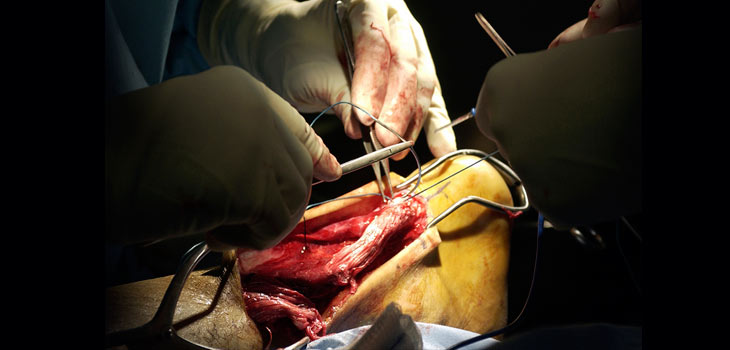
Miller is using a single continuous loop of non-absorbable suture to create a new way to restore the tendon’s length and tension. He believes that this technique speeds up the time it takes to return the patient to sports following surgery and strengthens the tendon long-term.
He says that this modified “giftbox” technique keeps the knots away from the tear site, while also decreasing the risk of suture laceration. Miller believes that this approach is especially appealing because the technique has shown improved suture pullout strength, particularly in severely damaged tissue. The idea, he says, is to use the suture to fortify the tendon after surgery and potentially help prevent future tendon re-tears.
Miller explains that the non-absorbable suture loop limits the number of times a surgeon can puncture the native tendon in the process of bringing the two ends of torn tendon together. But it also increases the number of suture strands that cross the tear site. Miller believes that this approach will make the tendon stronger after surgery.
To finish, Miller has moved the location of the suture knots that, literally, tie all these efforts together. He says that in the past, most surgeons knotted their sutures at the tear site. He has moved the knots away from the injury to allow for faster healing with fewer complications.
So far results have been promising. In 35 early patients who underwent surgery using this technique, Miller and his colleagues have seen good to excellent results in strength, rupture rate and return to previous level of activity. Miller and his colleagues believe patients may heal sooner and more completely simply by altering the way the sutures secure the two tendon stumps together.
For the quarter of a million people who will tear their Achilles tendon this year, Miller’s modification of the “giftbox” technique could suddenly and immediately become personally relevant.
Author
React:
Discussion
This is a fascinating development. In my practice we've seen similar outcomes with the revised protocol. The key differentiator seems to be patient selection criteria. Has anyone else noticed the correlation with BMI thresholds?
Great point. I'd push back slightly on the conclusion, the sample size in the cited study is too small to draw population-level inferences. That said, the directional signal is compelling and worth a larger RCT.
We implemented a similar approach last year. Early results are promising but we're still gathering 12-month follow-up data. Happy to share our protocol if anyone is interested.
Join the conversation
Orthopedic professionals are discussing this. Sign in and upgrade to read every comment and add your voice.