
“Patient satisfaction is better with unis, length of stay is much shorter, and complications are fewer, ” argues David Murray. “There are no proven clinical advantages to unis, ” says Steve MacDonald. “And they have a higher failure rate.”
Murray Debates MacDonald Over Mobile Unis
7 min read Premium comments
Great Debates
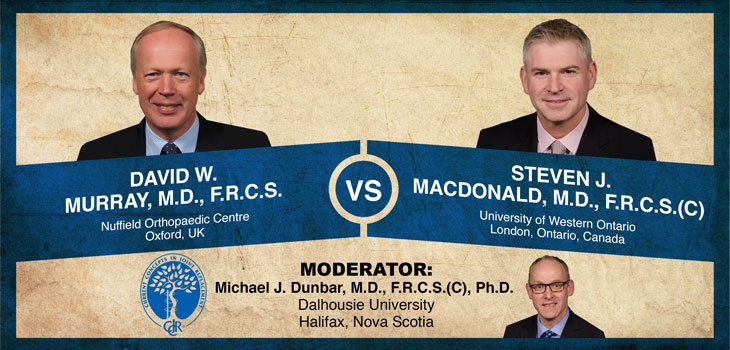
This week’s Orthopaedic Crossfire® debate is “The Mobile Uni: A Superior Solution for Medial Compartment Disease.” For the proposition is David W. Murray, M.D., F.R.C.S. of Nuffield Orthopaedic Centre in Oxford, UK. Steven J. MacDonald, M.D., F.R.C.S.(C) from the University of Western Ontario is in opposition. Moderating is Michael J. Dunbar, M.D., F.R.C.S.(C), Ph.D. of Dalhousie University in Halifax, Nova Scotia.
Mr. Murray: “One of the many questions here is, ‘Should you do a mobile or a fixed?’ But more importantly, ‘Should you do a uni or a total?’ Unis have many advantages over the total, but there is a higher revision rate with unis, particularly in the registries.”
“UK registry data shows that the revision rate of unis is 3x that of total knees. One reason is that the threshold for the revision of a uni is much less than a revision of a total. Data from New Zealand shows that if you have a bad outcome with a uni then 60% are revised; it’s only 10% after a total. And most surgeons do very small numbers of unis. A graph from the UK registry reveals that the most common number of unis per year is one, the second most common number is two, etc.”
“If surgeons are doing one or two a year they have a catastrophically high annual failure rate (4%). This is the primary reason why the revision rate is high. For years we have been trying to persuade surgeons to do 12 or more per year, but we failed. In retrospect that’s not surprising because surgeons cannot increase the size of their knee replacement practice, but they can increase the percentage of knees that are unis.”
“There are few surgeons doing more than 70% of their knees as unis. Surgeons doing 10% or less of their knees as unis have an unacceptably high revision rate. They should either stop…or do more.”
“The main indications for the mobile unis are anteromedial osteoarthritis, clearly defined with bone on bone in the medial compartment, intact anterior cruciate, correctible varus and full thickness lateral showing on the valgus stress x-ray.”
“So how does this all play out in the comparison between unis and totals in the registries? Well, there is a problem in these comparisons in that unis are done in younger and fitter patients than total knees. The only way you can compare them is by matching the cohorts.”
“As for the survival of unis and totals in matched patients, the revision rate of unis is still higher than totals, but only slightly (about 1.4x). Many would say that revision is not a good comparator…that a better one would be the overall reoperation rate.”
“If you do the same analysis looking at the overall reoperation rate then there is no difference between unis and totals up to eight years. So the whole problem disappears. Now we’ve got a huge matched dataset so we can compare things other than just revision. If we look at patient reported outcome measures we see that in the UK those patients with excellent outcomes—60% more unis have an excellent outcome than totals.”
“As for patient satisfaction, those with unis are 30% more likely to have ‘excellent’ satisfaction than those with a total. Length of stay is shorter with unis, and complications are fewer. Regarding the four most catastrophic medical complications (thromboembolism, deep infection, stroke, myocardial infarction) the incidence is between a third and a half with unis. A survival curve (up to a year) comparing death rates reveals that the death rate is higher with totals than unis. Within the first 30 days the death rate with totals is four times that of unis. Even out to eight years the death rate after totals is slightly higher than with unis (13% higher).”
“If you want to use unis and get good results, then you should use unis in 20-50% of your knee replacements. You use the mobile bearing with recommended indications. If you do this then patients will have a quicker recovery, a similar reoperation rate out to eight years, and fewer complications (and when they do occur they are less severe). And the death rate will be lower, both in the short and long term.”
Dr. MacDonald: “Well, I’ve been assigned to argue the correct side. I concede the mobile uni is superior—if you define superior as more costly, with a higher failure rate, less reproducible technique, and no proven clinical advantages.”
“I think we should avoid small, un-blinded series; there are some advantages to (and issues with) registries. At 13 years we have 400, 000 total knees and 40, 000 unis in the Australian registry. If you take all-comers then the failure rate is about triple (approaching 20% at 13 years). Not surprisingly, you see a slow, steady decline in the percentage of unis done each year. The revision rate is higher because a painful uni gets revised and a painful total knee rarely does…and the Australian registry can shed some light on that. If you look at the reasons that a uni fails, it’s about 50% are loose or have lysis. Only 11% of uni patients have unexplained pain; for total knees it’s 9.2%.”
“This registry also shows that women have a slightly higher (17-20%) cumulative revision rate. As for age, it has a huge impact whether you do a uni or a total. But if you’re younger than 55, you have a 30% revision rate at 13 years; it’s about half that if you do a total. In those over 75, there is a 9.3% revision rate at 13 years for a uni and only 3% for a total.”
“Some say, ‘A higher revision rate for a uni is offset by greater patient satisfaction.’ Really? The Swedish registry looked at 20, 000 patients and found the same percentage of ‘satisfied’ and ‘very satisfied’ patients.”
“In one paper they looked at the ‘forgotten joint’ score, i.e., someone has a total joint done and forgets about it. There were no differences in unis and total knees. One series from the Norwegian Arthroplasty Register looked at quality of life and 42 questions from the knee injury and osteoarthritis outcome score. They could only find one thing that was statistically significant: uni patients said they could bend their knees more fully, which makes sense. At our center we looked at Knee Society scores, SF-12, and Western Ontario and McMaster Universities scores, and saw postoperatively that unis had some higher scores; preoperatively they did as well.”
“Looking at David’s paper, we see a lower mortality rate in unis versus totals but with a higher revision rate. The collection period is 2003-2012 and the length of stay is 5.5 days versus 4. I don’t want to dismiss this; I want to understand the drivers to mortality. I think tourniquet times and length of stay are pretty similar, and how can resurfacing the lateral half of your knee cause you to die?”
“In many centers, unis are equally if not more expensive. There are other things that drive it, but the implant costs alone are often not cheaper—and that’s not considering the revision burden.”
Moderator Dunbar: “David, do you feel there’s an ideal age for unicompartmental mobile bearing?”
Mr. Murray: “On average, unis are done in younger patients than totals…that’s the reason unis have a higher failure rate. Our average age for unis is the same as totals. We do it in everybody who satisfies the criteria of anteromedial osteoarthritis. But surgeons are so frightened of unis that they only do them in patients where the rest of the knee is pristine; the only patients where the rest of the knee is pristine are those with early arthritis. Surgeons don’t want to do a total knee in these patients because they don’t do well. So they do a uni…and the patients do poorly.”
Moderator Dunbar: “Steve?”
Dr. MacDonald: “We have two doctors in our center who do unis…and they do it so that they can maintain a higher number.”
Moderator Dunbar: “Don’t dabble in unis!”
Mr. Murray: “We all think it’s the numbers that matter. You need to do a reasonable percentage of your knee replacements as unis—probably at least 20%. I think the appropriate indications are more important than the numbers.”
Moderator Dunbar: “Why do you think we’re fearful of doing a lot of unis?”
Dr. MacDonald: “I think our fear stems from looking at the results. If 50% of unis are being revised for loosening then there is an issue.”
Mr. Murray: “Yes, but that is registry data. If you are revising a uni for pain then you shouldn’t be…it doesn’t work. Most people would record it as loosening because when you have a uni you put a chisel on it, hit it and knock it off…and it’s filled in as loosening.”
Dr. MacDonald: “We all know you shouldn’t revise a painful total knee and it’s the same percent.”
Mr. Murray: “But if you hit a total knee it doesn’t come off. And the problem with a registry is that whatever you do you’re going to have a bad result in some patients. If it’s a uni, the patient will have a bad result, it will probably be converted to a total and do well. The patient will be happy, but according to the registry it’s a failure. If you have an unhappy person with a total then no one will revise it, the patient is unhappy, but according to the registry it’s a success.”
Dr. MacDonald: “Maybe all of that is true, but we’d have to ask the Australians if they are miscoding all of their cases.”
Mr. Murray: “As far as I know, there have been three reviews done on large numbers of surgeons, asking, ‘If you had medial compartment arthritis, would you have a uni?’ About 90% of surgeons would choose a uni.”
Dr. MacDonald: “Was the poll taken at a bar?”
Moderator Dunbar: “And we’re done! Thank you.”
Please visit www.CCJR.com to register for the 2015 CCJR Spring Meeting, May 17 – 20 in Las Vegas.
Author
React:
Discussion
This is a fascinating development. In my practice we've seen similar outcomes with the revised protocol. The key differentiator seems to be patient selection criteria. Has anyone else noticed the correlation with BMI thresholds?
Great point. I'd push back slightly on the conclusion, the sample size in the cited study is too small to draw population-level inferences. That said, the directional signal is compelling and worth a larger RCT.
We implemented a similar approach last year. Early results are promising but we're still gathering 12-month follow-up data. Happy to share our protocol if anyone is interested.
Join the conversation
Orthopedic professionals are discussing this. Sign in and upgrade to read every comment and add your voice.