
Endoscopic procedures can raise serious patient safety issues, as demonstrated by the recent “superbug” outbreak linked to reusable medical scopes at Cedars-Sinai Medical Center. Reusable arthroscopes also get damaged, worn out and cost money to clean up.
Integrated Endoscopy Says It Has a Safer Arthroscope
2 min read Premium comments
Secondary
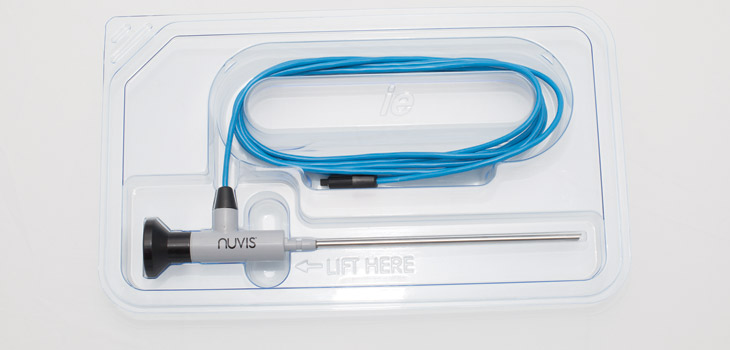
Integrated Endoscopy, Inc. says it has the solution with its single-use nuvis Arthroscope. The company is launching the device at the 2015 American Academy of Orthopaedic Surgeons (AAOS) annual meeting in Las Vegas at the end of March. The FDA 510k cleared the device last July.
nuvis Arthroscope
The nuvis is disposable and, according to George Wright, the company’s president and CEO, is the first such device based “on 21st century optical technology. Its excellent optics and improved safety provide first-time quality for every procedure, benefiting surgeons and patients alike.”
The arthroscope has 12 molded glass lenses compared with 32–56 lenses typically used in reusable arthroscopes, according to the company. “These high-quality lenses are made with the same technology and low-temperature glass used to mass-produce high-definition, low-cost optics for smart phone cameras. The nuvis Arthroscope also features patented light-emitting diode (LED) technology that provides improved white light at significantly lower temperatures than the fiber optic illumination used in conventional endoscopes, ” said the company statement.
Lower Maintenance Costs
Wright also said the scope is affordable and “compares favorably” to reusable endoscopes after accounting for the total cost of ownership. The device eliminates the need for “reprocessing between use, scope damage and repair costs, operating room downtime, and inventory logistical issues.”
“Surgeons now can have first-time optical quality for every arthroscopy procedure…and patients can be assured of a sterile scope free of the potential for infection transmission, ” said Grady Jeter, M.D. founder of the Arthroscopy & Sports Medicine Clinic in San Jose, California.
Jeter says surgeons rarely have the opportunity to use a brand new arthroscope and the availability of an affordable single-use arthroscope is a “major advance both in terms of optical quality and patient safety…”
The company cites recent market research which showed approximately 8.3 million arthroscopic procedures performed in 2013 in the U.S. and Europe. That’s expected to grow to over 10 million annually by 2017. Orthopedic surgery, says the company, is the fastest growing endoscopic surgery segment, with a projected compound annual growth rate in the U.S. and Europe of about 9.2% between 2011 and 2016.
There will be surgeons and investors at the AAOS meeting. The company is making a case for both audiences.
Wright says the company’s “strong” patent position makes the company “uniquely positioned to be the market leader and sole provider of high-quality, low-cost single-use rigid endoscopes.” The Rancho Santa Margarita, California, company was founded in 1996.
The device is expected to be available nationwide later in the year.
Author
React:
Discussion
This is a fascinating development. In my practice we've seen similar outcomes with the revised protocol. The key differentiator seems to be patient selection criteria. Has anyone else noticed the correlation with BMI thresholds?
Great point. I'd push back slightly on the conclusion, the sample size in the cited study is too small to draw population-level inferences. That said, the directional signal is compelling and worth a larger RCT.
We implemented a similar approach last year. Early results are promising but we're still gathering 12-month follow-up data. Happy to share our protocol if anyone is interested.
Join the conversation
Orthopedic professionals are discussing this. Sign in and upgrade to read every comment and add your voice.