
IlluminOss Medical has announced that the first of 45 patients has been enrolled in its EU Light Fix trial. The trial is for the treatment of impending and pathologic fractures in the humerus due to metastatic carcinoma. Professor Reinhard Windhager, M.D. of the University Clinic of Vienna Orthopaedic Department, is leading these efforts. Dr. Windhager heads the Department of Orthopaedic Surgery at Vienna General Hospital (AKH). The trial will involve 10 centers in Austria, Germany and the Netherlands; the first patient enrolled is a female with metastatic cancer of the left humerus.
IlluminOss Enrolls First Patient in Light Fix Trial
2 min read Premium comments
Secondary
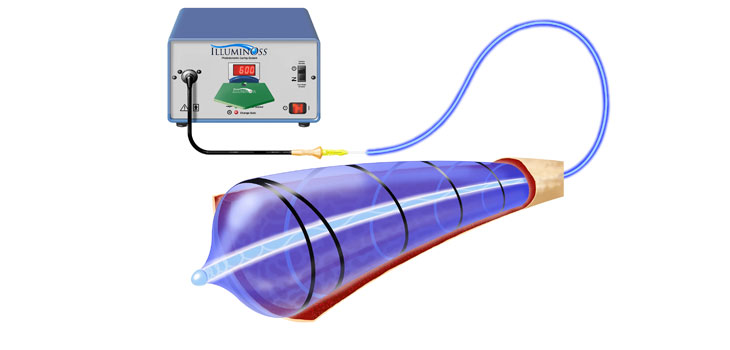
The IlluminOss System utilizes a light-curable polymer, contained within an expandable balloon catheter, to achieve bone stabilization. The simple, percutaneous surgical approach enables surgeons to create a patient-conforming implant. In many cases it allows the patient to get back to daily activities more quickly without the hindrance of a hard cast. Benefits observed from the use of the product in patients include smaller incisions, shorter procedure times, and more rapid post-procedure patient mobility with reduced hospital stays and lower complication rates. The small diameter of the flexible catheter gives the surgeon greater freedom of surgical approach. Once cured, the implant provides longitudinal strength and rotational stability over the length of the implant.
“The IlluminOss System will potentially allow orthopedic surgeons to approach impending and actual fractures resulting from metastatic malignancy in a groundbreaking way that will benefit both the surgeon and the patient, ” said Professor Windhager in the March 3, 2015 news release. “I am pleased to lead the first Light Fix trial in the EU and hope our efforts will help validate an approach to orthopedic surgery that can provide treatment options for patients that previously had little or no recourse and also potentially lessen complications and improve outcomes.”
“We are honored that Professor Windhager and Vienna General Hospital have chosen to collaborate with IlluminOss Medical on this important trial for the repair and stabilization of impending and pathologic fractures in the humerus due to metastatic carcinoma, ” said Robert Rabiner, president of IlluminOss Medical. “The University Clinic of Vienna Orthopaedic Department has a long tradition of providing the highest standards of patient care, and we believe its practices influence orthopedic treatment approaches throughout Austria and the surrounding European region. Together with our valued Austrian distributor, Cherry Med Medical Solutions, we expect the IlluminOss System will present a superior way to approach the repair of fractures resulting from metastatic carcinoma.”
Rabiner told OTW, “We are excited to enroll the first patient in the EU Light Fix trial and plan to enroll up to 45 patients in total at approximately 10 centers in Austria, Germany and the Netherlands. We are confident that the results of the trial will ultimately serve to further validate the IlluminOss System as a true disruptive technology in the way fracture repair can be approached.”
React:
Discussion
This is a fascinating development. In my practice we've seen similar outcomes with the revised protocol. The key differentiator seems to be patient selection criteria. Has anyone else noticed the correlation with BMI thresholds?
Great point. I'd push back slightly on the conclusion, the sample size in the cited study is too small to draw population-level inferences. That said, the directional signal is compelling and worth a larger RCT.
We implemented a similar approach last year. Early results are promising but we're still gathering 12-month follow-up data. Happy to share our protocol if anyone is interested.
Join the conversation
Orthopedic professionals are discussing this. Sign in and upgrade to read every comment and add your voice.