
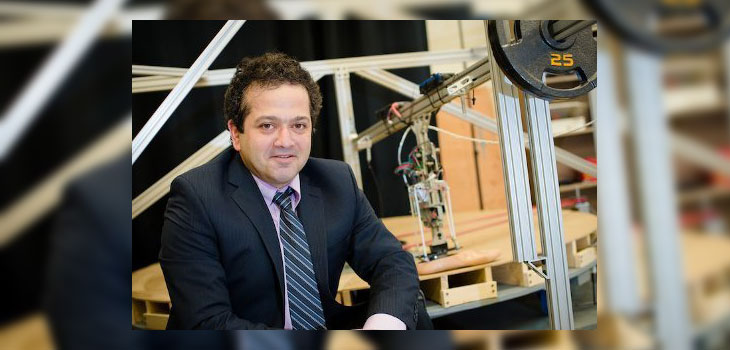
From a publication called Orthopedic Design and Technology comes word of a robotic ankle that can see where it is going. Mo Rastgaar, a Michigan Technological University mechanical engineer, and his team have developed a prototype of a prosthetic ankle that can move in a way that mimics a natural gait. Now, they aim to give their robotic ankle eyes. “We are developing an artificial vision system, ” said Rastgaar.
Eyes on a Robotic Ankle? Why Not?
1 min read Premium comments
Secondary
The key components are a camera and a computer-controlled actuator, which adjusts the ankle’s position through a system of cables. “The camera can identify the profile of the ground, while the computer knows where the next footstep will be, based on how the user is moving the leg, ” Rastgaar said.
He explained that the computer analyzes the information from the camera and applies the correct angle and stiffness to the ankle, just as an individual does when walking on his own biological foot and ankle. The ankle, Rastgaar says, adapts precisely, whether the user is climbing stairs or striding over a pothole.
Rastgaar says that the foot is moved by lines that are similar to bicycle brake cables. The actuator does not have to be mounted on the prosthesis but can be carried in a pocket or fanny pack. It is also easy to remove so a user can use it or not, depending on his or her needs. “If the user is going to stay at home, it might be simpler to walk around the house with a passive prosthesis, ” Rastgaar said. “One of these days, we hope this can be brought to market, where it could really help people.”
The research is being funded by a grant from the National Science Foundation. Involved are researchers from Michigan Technological University, the Mayo Clinic and the Massachusetts Institute of Technology.
Author
React:
Discussion
This is a fascinating development. In my practice we've seen similar outcomes with the revised protocol. The key differentiator seems to be patient selection criteria. Has anyone else noticed the correlation with BMI thresholds?
Great point. I'd push back slightly on the conclusion, the sample size in the cited study is too small to draw population-level inferences. That said, the directional signal is compelling and worth a larger RCT.
We implemented a similar approach last year. Early results are promising but we're still gathering 12-month follow-up data. Happy to share our protocol if anyone is interested.
Join the conversation
Orthopedic professionals are discussing this. Sign in and upgrade to read every comment and add your voice.