
The government says more than 16.4 million people have signed up for health coverage since the inception of the Affordable Care Act (Obamacare) five years ago.
Drop in Uncompensated Care Equals $7 Billion Hospital Windfall
3 min read Premium comments
Secondary
That has turned into a multi-billion windfall for hospitals and state governments. It’s an even bigger windfall for states that voluntary expanded Medicaid coverage in their states.
In 2014, the first full year of expanded coverage, the cost of uncompensated care at all hospitals fell by $7.4 billion to $27.3 billion. Without the expansion of coverage in the Medicaid program, the cost of uncompensated care would have been about $34.7 billion.
Reduction in Uninsured Admissions
Makes sense. A March 23, 2015 report from the U.S. Department of Health and Human Services (HHS), found there were substantial reductions in the volume of admissions of uninsured and self-paying patients in states that have expanded Medicaid, while in nonexpansion states those volumes “have fallen slightly.” Such patients are responsible for a “major portion” of uncompensated care by hospitals, the department said.
The report added that most of the reduction came from the 28 states and Washington, D.C., which expanded Medicaid health coverage for the poor, with a reduction in uncompensated care of $5 billion and bad debt of $1.1 billion. Even states that didn’t expand Medicaid, however, reduced these costs. Those states had a $2.4 billion drop in uncompensated care costs and an $800 million drop in bad debt.
Some States Missing Out
That’s a shame for states that didn’t expand, because the federal government pays 100% of the expanded coverage costs until 2016, and then eventually 90% by 2020. Taxpayers in those states that didn’t expand pay equally into the same federal kitty as states that expanded. But they don’t get the benefits.
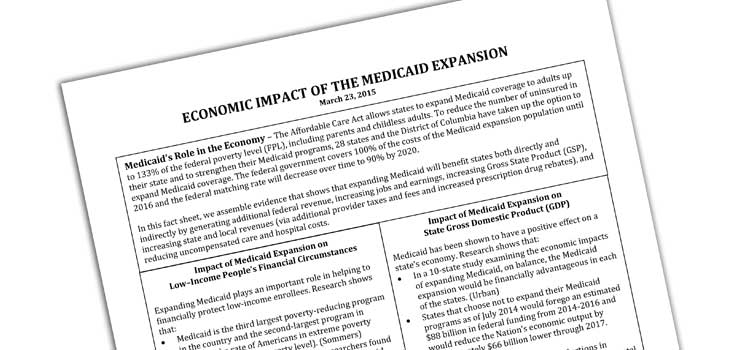
States that didn’t expand will forgo around $88 billion in federal funding from 2014-2016 and will reduce the nation’s economic output by approximately $66 billion lower through 2017, according to the report. The HHS report said that “if nonexpansion states had proportionately as large increases in Medicaid coverage as did expansion states, their uncompensated care costs would have declined by an additional $1.4 billion.”
The Winners
Kentucky, the home of U.S. Senators Mitch McConnell and Rand Paul, is the first state with a post-expansion report. The estimated economic contribution of expanded coverage is expected to be $30.1 billion from 2014 to 2021. The Kentucky report also said that there will be a net positive impact on their state budget of $919.1 million and job growth of 12, 000 jobs.
Some of the big winners of estimated net economic impact on their states include Ohio, the home state of U.S. House Speaker John Boehner, with an expected $18 to $19 billion impact. The big winner is Alabama expecting to gain $20 billion, while Arkansas and Missouri anticipate around a $9 billion.
Community Health Systems (CHS), Hospital Corporation of America, LifePoint and Tenet recorded sharp drops in the rate of uninsured/self-paying admissions over the course of last year. CHS saw the largest decreases, with a 28% reduction in uninsured admissions in expansion states in the first quarter of 2014, and a 73% drop in the fourth quarter of 2014.
The report noted all states also reduced their charity care costs. Expansion states accounted for a $3.9 billion drop and states that did not expand Medicaid accounted for $1.6 billion in reduced costs.
Projections used in the report came from the Assistant Secretary of Professional Estimators, the principal advisor to the department of Health and Human Services; the Centers for Medicare and Medicaid Services Hospital Cost Report data; 2014 uninsured estimates from Gallup-Healthways, and CMS Medicaid enrollment numbers. It was prepared by ASPE, a division of HHS.
Author
React:
Discussion
This is a fascinating development. In my practice we've seen similar outcomes with the revised protocol. The key differentiator seems to be patient selection criteria. Has anyone else noticed the correlation with BMI thresholds?
Great point. I'd push back slightly on the conclusion, the sample size in the cited study is too small to draw population-level inferences. That said, the directional signal is compelling and worth a larger RCT.
We implemented a similar approach last year. Early results are promising but we're still gathering 12-month follow-up data. Happy to share our protocol if anyone is interested.
Join the conversation
Orthopedic professionals are discussing this. Sign in and upgrade to read every comment and add your voice.