
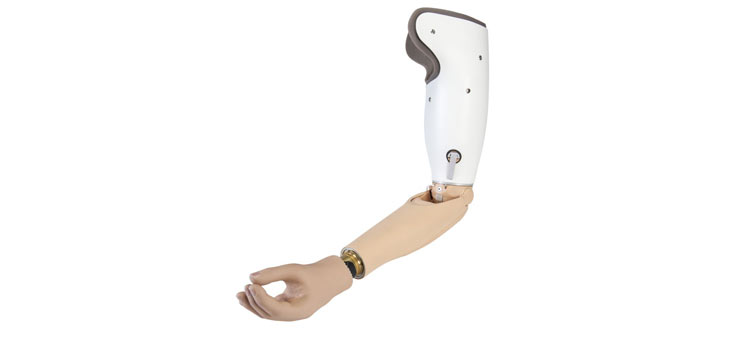
Ottobock’s prosthetic hand, with four movable fingers and a positionable thumb uses electrical signals originating in the brain to crate movement. The device has recently been cleared by the U.S. Food and Drug Administration for promotion in the U.S.
Brain Commands Move Prosthetic Hand
1 min read Premium comments
Secondary
Called the Michelangelo Hand, users of the device say that it looks and feels like a real hand and has seven positions that enable it to manage a variety of tasks. “It’s the closest thing to a second hand I’ve had since I became an amputee 30 years ago, ” said attorney and Michelangelo user Andrew Carter in a statement to Fierce Medical Devices writer Stacy Lawrence.
The hand’s myoelectric controls work via an electrode that is placed on the surface of the wearer’s residual limb. Motors and microprocessors within the prosthetic hand create the gripping and rotating movements.
Carter added, “It’s designed to accommodate movements as fine as sorting money, transporting large objects or even performing delicate mechanical tasks. The prosthetic can help facilitate everyday tasks such as hanging clothes, holding a plate, cooking and riding a bicycle.”
Ottobock is the American corporate division of the German company Ottobock HealthCare, a firm with 7, 000 employees worldwide. The company offers 50, 000 different kinds of orthotic and rehabilitation products.
Author
React:
Discussion
This is a fascinating development. In my practice we've seen similar outcomes with the revised protocol. The key differentiator seems to be patient selection criteria. Has anyone else noticed the correlation with BMI thresholds?
Great point. I'd push back slightly on the conclusion, the sample size in the cited study is too small to draw population-level inferences. That said, the directional signal is compelling and worth a larger RCT.
We implemented a similar approach last year. Early results are promising but we're still gathering 12-month follow-up data. Happy to share our protocol if anyone is interested.
Join the conversation
Orthopedic professionals are discussing this. Sign in and upgrade to read every comment and add your voice.