
Despite enormous efforts to stop joint infection, the problem persists. In continuing their search for answers, researchers from Thomas Jefferson University and the National Institutes of Health have found new information on why infections occur even after antibiotics are administered.
Bacterial “Clumps” Stay in Joints, Cause Infection
1 min read Premium comments
Secondary
“In this study, we decided to find out if pre-operative, prophylactic antibiotic concentrations in joint fluid samples from patients were sufficient to prevent Staphylococcus aureus and MRSA contamination, ” said Noreen Hickok, Ph.D., associate professor in the Department of Orthopedic Surgery in the Sidney Kimmel Medical College at Thomas Jefferson University, in the March 17, 2015 news release. “We found that high concentrations of the preferred antibiotic cefazolin are present in the synovial fluid. But when bacteria are introduced into this environment, the bacteria survive and continue to grow and form clumps.”
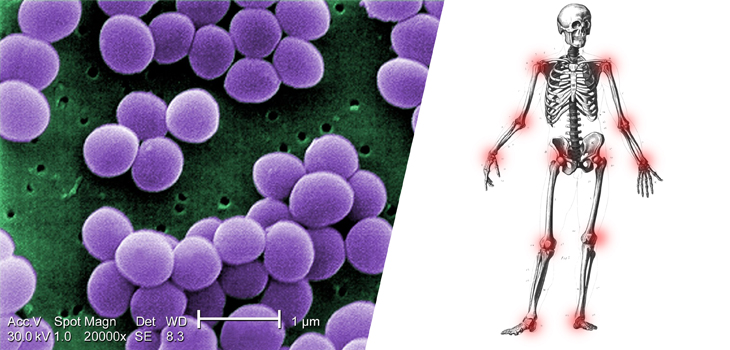
The researchers noted that when Staphylococcus aureus was introduced into joint fluid, the bacteria was still able to colonize implant surfaces, and form biofilms. They postulate that the persistence of these bacteria in synovial fluid containing antibiotics may be one reason that joint infection is difficult to cure.
The research team had previously identified these floating biofilm-like clumps of bacteria as a source of antibiotic-resistant joint infections. “These biofilm-like clumps arise because bacteria embed themselves in a protective mesh of proteins that resist the penetration of antibiotics. They also found that the bacteria slow their growth, making them even less susceptible to antibiotics, which are designed to target rapidly growing cells like bacteria.”
“The next step is to see how we can disperse these mega-clusters of buried bacteria. If we can provide a window for antibiotics to carry out their intended function, we can move towards a clinical model and ultimately cure joint infection, ” offered Sana Dastgheyb, Ph.D., lead author on this study and researcher at both Thomas Jefferson University and the National Institutes of Health.
Author
React:
Discussion
This is a fascinating development. In my practice we've seen similar outcomes with the revised protocol. The key differentiator seems to be patient selection criteria. Has anyone else noticed the correlation with BMI thresholds?
Great point. I'd push back slightly on the conclusion, the sample size in the cited study is too small to draw population-level inferences. That said, the directional signal is compelling and worth a larger RCT.
We implemented a similar approach last year. Early results are promising but we're still gathering 12-month follow-up data. Happy to share our protocol if anyone is interested.
Join the conversation
Orthopedic professionals are discussing this. Sign in and upgrade to read every comment and add your voice.