
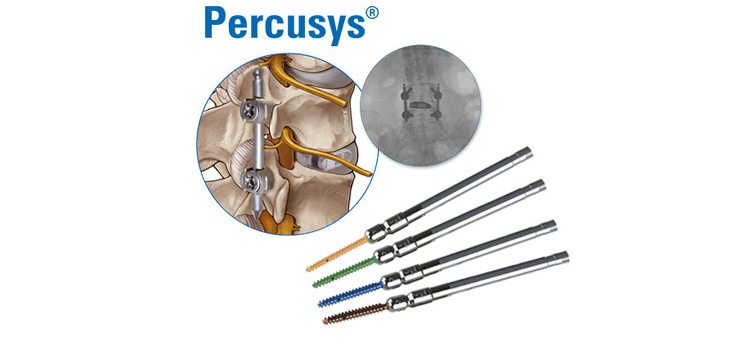
joimax, a German company focusing on technologies and training for minimally invasive endoscopic spinal surgery, is announcing the receipt of 510(k) clearance from the FDA to market its Percusys percutaneous pedicle screw-rod system. With a focus on simplicity, the single, small instrument set is used to perform surgery through a percutaneous, minimally invasive or open approach.
510k for joimax’s Percusys
1 min read Premium comments
Secondary
“During development, the main focus was on the ease-of-use of the system, ” says Dr. Frank Hassel, specialist for spine surgery from Freiburg, Germany, in the March 4, 2015 news release. Dr. Hassel, who was instrumental to the Percusys development, added, “The idea was to reduce the complexity in instrumentation and simplify stabilization procedures to minimize the potential damage of soft tissues and improve overall patient outcomes.”
According to the news release, each surgical step is carried out using the lengthening shaft, which is tightly connected to the tulip. The assembly allows for direct manipulation and does not require additional instrumentation. Shearing off the lengthening shaft can be done by a 360-degree rotation of the shaft breaker.
Percusys can be used in combination with the joimax EndoLIF O-Cage. “This offers an optimal solution for minimally invasive, endoscopic-assisted access to the intervertebral disc, ” says Wolfgang Ries, CEO and founder of joimax. “Percusys represents the next logical step in the development of endoscopic surgery and further strengthens the joimax position as an expert in this special market segment.”
Asked about milestones during the development process, Dr. Hassel told OTW, “The first was designing a true minimally invasive percutaneous screw that meets all kind of application needs, is simple to use with combined features, and is always at hand (sterile pre-packed).”
“The second milestone was minimizing the hassle of complex instruments (stacked in many trays, lots of surgical steps). This allowed us to simplify a rather straight forward surgery, meaning that the surgical team has more time to look after the patient.”
React:
Discussion
This is a fascinating development. In my practice we've seen similar outcomes with the revised protocol. The key differentiator seems to be patient selection criteria. Has anyone else noticed the correlation with BMI thresholds?
Great point. I'd push back slightly on the conclusion, the sample size in the cited study is too small to draw population-level inferences. That said, the directional signal is compelling and worth a larger RCT.
We implemented a similar approach last year. Early results are promising but we're still gathering 12-month follow-up data. Happy to share our protocol if anyone is interested.
Join the conversation
Orthopedic professionals are discussing this. Sign in and upgrade to read every comment and add your voice.