
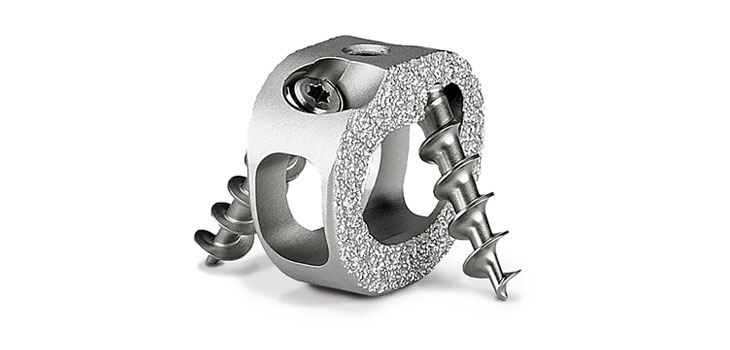
Titan Spine, LLC is celebrating the receipt of a 510(k) clearance from the U.S. Food and Drug Administration (FDA) for the release its Endoskeleton TCS, an interbody fusion device for the cervical spine with integrated fixation.
Titan Spine: 510(k) for Endoskeleton TCS
2 min read Premium comments
Secondary
The TCS utilizes Titan’s proprietary surface technology. It is part of the fusion process in that it creates an osteogenic response to the implant’s topography. According to the February 12, 2015 news release, “The topography consists of a unique combination of roughened topographies at the macro, micro, and cellular levels. This unique combination of surface topographies is designed to create an optimal host-bone response and actively participate in the fusion process by promoting the upregulation of osteogenic and angiogenic factors necessary for bone growth, encouraging natural production of bone morphogenetic proteins (BMPs), and creating the potential for a faster and more robust fusion.”
Titan President Kevin Gemas commented, “We are proud to launch the Endoskeleton TCS as the latest addition to our surface engineered interbody device portfolio that continues to challenge the status quo in the interbody fusion marketplace. Like the rest of our products, the TCS is designed to benefit patients by affecting their healing process where it matters most—at the cellular level. The roughened surface technology featured on the TCS is created through a proprietary process that has been shown to produce a superior environment for bone growth at the cellular level when compared to PEEK. In addition, it has several advantages compared to PEEK devices with titanium plasma spray (TPS) coated devices. Most importantly, our surface is created through a proprietary subtractive process rather than an additive coating, which eliminates the potential for delamination and/or particulate debris when compared to products with a PEEK-titanium interface.”
“The Endoskeleton TCS device is designed for integrated fixation with two surface-enhanced screws that provide for immediate implant mechanical stability. The screws incorporate an anti-backout feature that do not lock the screws to the implant and allow up to 39 degrees of medial-lateral (M/L) and 29 degrees of anterior-posterior (A/P) angulation post-implantation.”
Chief Medical Officer Paul Slosar, M.D. performed the first surgery using the Endoskeleton TCS on February 9, 2015 at Saint Francis Memorial Hospital in San Francisco, California. Dr. Slosar commented to OTW, “One of our biggest challenges we encountered while designing the TCS was to maintain the features of our standalone ALIF device that work well while adding an anti-backout feature to the screws. Specifically, we wanted to retain our macro anti-expulsion surface, a large hole that allows for variable angle screw trajectory, and a screw that acts independently of the cage. Using these design criteria as a starting point, our engineers were then able to incorporate an anti-backout feature consisting of an innovative collar on the screw head that deploys after crossing past a pinch point in the screw hole during insertion. This provides for a screw that is easy to insert, does not add profile to the implant, and acts as a solid anti-backout feature.”
React:
Discussion
This is a fascinating development. In my practice we've seen similar outcomes with the revised protocol. The key differentiator seems to be patient selection criteria. Has anyone else noticed the correlation with BMI thresholds?
Great point. I'd push back slightly on the conclusion, the sample size in the cited study is too small to draw population-level inferences. That said, the directional signal is compelling and worth a larger RCT.
We implemented a similar approach last year. Early results are promising but we're still gathering 12-month follow-up data. Happy to share our protocol if anyone is interested.
Join the conversation
Orthopedic professionals are discussing this. Sign in and upgrade to read every comment and add your voice.