
What to you do if you are 24 years-old, have had three failed surgeries on your leg to treat multiple point recurrent cancer of the leg bone and live in Uzbekistan? The young man, Sobidji, went to India.
Rare Total Femoral Leg Replacement Surgery
1 min read Premium comments
Secondary
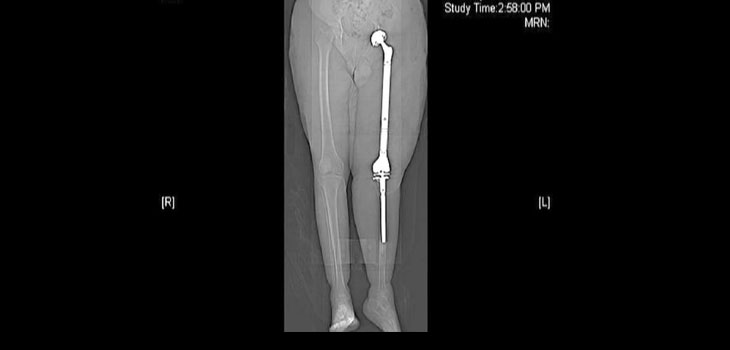
In India Rajeev K. Sharma, M.D., a senior consultant in orthopedics, and a joint replacement surgeon performed an extremely rare form of total femoral replacement surgery on him. The doctors removed the entire cancer-affected bone extending from the hip to the knee and replaced it with an artificial Total Femoral Replacement Implant.
Dr. Rajeev K Sharma, senior consultant, orthopedics & joint replacement surgeon at Indraprastha Apollo Hospitals, New Delhi, participated in the surgery. He said, “Total femoral replacement in this case was a very difficult and rare surgery as it was a kind of a combination of hip replacement, knee replacement and thigh bone replacement. To be able to get rid of the cancer completely, we needed to remove the entire stretch of thigh bone from the right hip to the right knee and reconstruct the same artificially.”
The challenges faced by the surgeons included the threat of post-surgical infection, knee and hip instability and damage to the nerves and vessels of the area. The successful surgery, which took more than eight hours, not only rid Sobidji of cancer; it gave him a new hip and knee joint, as well as a fresh lease on life. Doctors report that he is responding well to the treatment.
Author
React:
Discussion
This is a fascinating development. In my practice we've seen similar outcomes with the revised protocol. The key differentiator seems to be patient selection criteria. Has anyone else noticed the correlation with BMI thresholds?
Great point. I'd push back slightly on the conclusion, the sample size in the cited study is too small to draw population-level inferences. That said, the directional signal is compelling and worth a larger RCT.
We implemented a similar approach last year. Early results are promising but we're still gathering 12-month follow-up data. Happy to share our protocol if anyone is interested.
Join the conversation
Orthopedic professionals are discussing this. Sign in and upgrade to read every comment and add your voice.