
Who would have guessed that mechanical forces exerted on stem cells would trigger a key signaling pathway that would determine what kind of tissue the cell would develop into? The first step took place when bioengineer Yingxiao Wang, University of California, San Diego, squeezed a tiny bead attached to the outside of a human stem cell. The squeeze released calcium ions stored inside the cell and allowed them to flow through opened up channels in the cell membrane.
Optical “Tweezers” Squeeze Stem Cells to Initiate Change
2 min read Premium comments
Secondary
Ioana Patringenaru, writing for R & D, explains that Wang’s work shows that mechanical forces, such as the squeeze, exerted on stem cells determine how the cells produce all kinds of tissues, “from blood to bone, from scratch, ” she wrote.
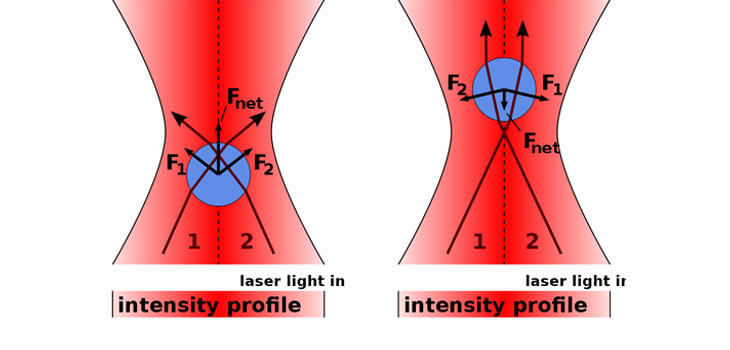
According to Patringenaru, Wang and his colleagues used a highly focused laser beam to create an optical “tweezers” to apply force to the bead. The squeeze applied by the tweezers was extremely small—on the order of about 200 pico newtons.
When there were no calcium ions circulating outside the cell, this squeeze released calcium ions from a structure inside the cell called the endoplasmic reticulum. The researchers noted that when the force triggered the movement of calcium ions into the cell from its extracellular environment, only the cytoskeleton was involved.
Wang noted that calcium ions help deliver a number of important cell signals. “They often trigger a molecular cascade inside cells, and can send signals to the cell nucleus that can turn on or off gene expression, ” he said.
Wang’s findings, published in eLife, will help researchers understand “the functional mechanisms behind stem cell differentiation, ” said Wang. “The mechanical environment around a stem cell helps govern a stem cell’s fate, ” he said. “Cells surrounded in stiff tissue such as the jaw, for example, have higher amounts of tension applied to them, and they can promote the production of harder tissues such as bone.”
Patringenaru explained that” stem cells living in tissue environments with less stiffness and tension, on the other hand, may produce softer material such as fat tissue.”
She quoted Wang as saying that this type of signaling may be one link between the mechanical forces acting on a stem cell and its transformation into other cell types. She reports that Wang’s research team plans “to study the impact of mechanical force on other signaling pathways in a variety of cell types, to learn more about how they could regulate cell fate.”
Author
React:
Discussion
This is a fascinating development. In my practice we've seen similar outcomes with the revised protocol. The key differentiator seems to be patient selection criteria. Has anyone else noticed the correlation with BMI thresholds?
Great point. I'd push back slightly on the conclusion, the sample size in the cited study is too small to draw population-level inferences. That said, the directional signal is compelling and worth a larger RCT.
We implemented a similar approach last year. Early results are promising but we're still gathering 12-month follow-up data. Happy to share our protocol if anyone is interested.
Join the conversation
Orthopedic professionals are discussing this. Sign in and upgrade to read every comment and add your voice.