
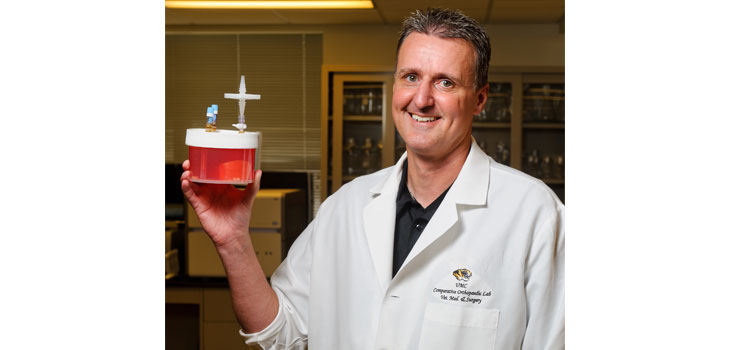
Thanks to researchers at the University of Missouri School of Medicine, doctors will not have to jettison tissue that is donated for joint replacements. At present, says the January 28, 2015 news release, doctors have to throw away more than 80% of donated tissue used for joint replacements because the tissue does not survive long enough to be transplanted. With a new technology known as the Missouri Osteochondral Allograft Preservation System, (MOPS), the life of donated tissue is more than doubled—without a decrease in quality.
New Technology Doubles Life of Tissue
2 min read Premium comments
Secondary
“It’s a game-changer, ” said James Stannard, M.D., co-author of the study and J. Vernon Luck Sr. Distinguished Professor of Orthopaedic Surgery at the University of Missouri School of Medicine, news release. “The benefit to patients is that more graft material will be available and it will be of better quality. This will allow us as surgeons to provide a more natural joint repair option for our patients.”
To date, donated tissues have been stored within a medical-grade refrigeration unit in sealed bags filled with a standard preservation solution. With MOPS there is a new preservation solution and special containers—designed by the research team—that allow the tissues to be stored at room temperature. When the scientists compared the two preservation techniques, they found that the MOPS technology allowed for clinical outcomes to be extended to at least 60 days, versus the current storage time of approximately 28 days. The study also found that the MOPS preservation system resulted in a 100% rate of usable tissue grafts at 60 days after procurement.
“Time is a serious factor when it comes to utilizing donated tissue for joint repairs, ” said study co-author James Cook, D.V.M., Ph.D. director of the University of Missouri Comparative Orthopaedic Laboratory and the Missouri Orthopaedic Institute’s Division of Research. “With the traditional preservation approach, we only have about 28 days after obtaining the grafts from organ donors before the tissues are no longer useful for implantation into patients. Most of this 28-day window of time is used for testing the tissues to ensure they are safe for use. This decreases the opportunity to identify an appropriate recipient, schedule surgery and get the graft to the surgeon for implantation.”
Dr. Cook told OTW, “The Missouri Osteochondral Allograft Preservation System was developed to extend the storage time of donor tissue and preserve it at a higher quality level than with current methods. The new system includes a serum-free specialized culture media with numerous FDA-approved additives stored in a filtered chamber that does not require specialized incubation conditions.”
Dr. Cook, who also serves as the William and Kathryn Allen Distinguished Professor in Orthopaedic Surgery at the University of Missouri School of Medicine, leads the research team that developed the new bone-and-cartilage-preservation technology.
Author
React:
Discussion
This is a fascinating development. In my practice we've seen similar outcomes with the revised protocol. The key differentiator seems to be patient selection criteria. Has anyone else noticed the correlation with BMI thresholds?
Great point. I'd push back slightly on the conclusion, the sample size in the cited study is too small to draw population-level inferences. That said, the directional signal is compelling and worth a larger RCT.
We implemented a similar approach last year. Early results are promising but we're still gathering 12-month follow-up data. Happy to share our protocol if anyone is interested.
Join the conversation
Orthopedic professionals are discussing this. Sign in and upgrade to read every comment and add your voice.