
“Why choose a delta (ceramic) versus a cobalt-chrome head? There’s no evidence of decreased revision rates with a delta head and it’s more expensive, ” says Steve MacDonald. “If you look at the level one data that is available, ” says Fares Haddad, “and look at the long term outcome, you will move away from cobalt-chrome heads.”
MacDonald, Haddad Debate Femoral Head Materials
6 min read Premium comments
Great Debates
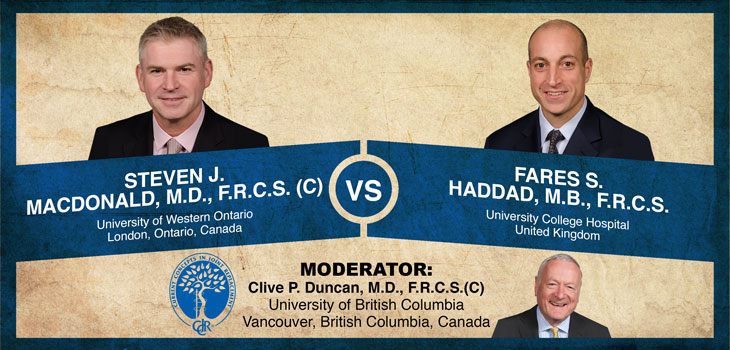
This week’s Orthopaedic Crossfire® debate is “Femoral Head Materials…No Difference in Outcomes.” For the proposition is Steven J. MacDonald, M.D., F.R.C.S. (C) of the University of Western Ontario. Fares S. Haddad, M.B., F.R.C.S. from University College Hospital in the UK. Moderating is Clive P. Duncan, M.D., F.R.C.S.(C) of the University of British Columbia.
Dr. MacDonald: “The debate is cobalt-chrome versus a ceramic or delta head. About five years ago we were at the peak of hard-on-hard bearings, with metal-metal and ceramic-ceramic constituting about a third of the total hips done. That’s changed substantially as currently about 92% are highly crosslinked polyethylene (XLPE). Now the debate is, ‘Against what counter surface? ”
“A recent publication from the Australian registry includes 250, 000 total hips taken out to 10 years. The lowest cumulative revision rate was cobalt chrome on XLPE (4.3%); in second place was ceramic on XLPE (4.6%). So clinically, they seem to be doing pretty much the same. If you look at the head size in XLPE at seven years there is no difference in the cumulative revision rate for 36 and 32mm…not the really large heads.”
“So what’s the trend in femoral head material choice? Increasingly, it is towards the use of a ceramic head and away from a metal head. But not all ceramics are created equal. About 90% of the market is using a mixed ceramic (delta) head…so why choose a delta versus a cobalt-chrome head? There’s no evidence of decreased revision rates with a delta head, and there’s no evidence for decreased, clinically relevant wear rates. And you can show hip simulators against XLPE where there are subtle differences, but both cobalt chrome and ceramic are well below the osteolysis potential, and it’s hard to imagine that this is going to bear out clinically.”
“One of the challenges is that in many countries and institutions the delta ceramic comes at a significant price premium. At my institution ceramic heads are twice the cost of cobalt-chrome heads. So why choose delta? Taper corrosion. A case series from Rush Orthopedics (nearly 20 patients) found taper corrosion with a cobalt-chrome head against XLPE. They weren’t all large heads; most were 28mm. Clive Duncan and his group published a case series (retrieval study) on hip arthroplasty and found that even a ceramic head had taper corrosion.”
“What is the actual corrosion rate of a cobalt-chrome ball and a standard taper? We have no idea. So let’s be clear that corrosion is multifactorial. While head material may be clinically relevant at this point we don’t have any evidence of that. We have no idea of the global incidence or prevalence, and no idea of the true clinical reduction that a delta head would give you over cobalt chrome.”
“Regarding cost benefit analysis, here is the challenge at my institution: it’s a $400 premium to do a delta head. What is the reduction in the incidence of clinically relevant taper corrosion with a delta? I don’t know. Is it 1 in 1, 000? That would be a cost of $400, 000 to prevent one case.”
“Delta ceramic is not the ultimate solution. As for the issue of fracturing, the delta ceramic fracture rate is rare. In Australia it’s about 1 in 70, 000. So if you choose a delta head you must accept that there’s no clinical superiority; you’re hoping for a lower corrosion rate, but who knows. And you have to accept the cost differential. I think you choose a cobalt-chrome head because you do have evidence for clinical superiority or at the very least, equivalence. In summary, choosing a cobalt-chrome head means that you’re inherently more intelligent.”
Mr. Haddad: “You could be fooled by Steve’s intelligence and charm, but I took the issue to my children. When they looked at the different types of heads it was clear that they preferred the pink and black ones. I will share the literature and you will see why.”
“The difference depends on what you look at…and especially how hard you look. You have to look at wear, corrosion, and high level activities—and you have to look long-term. Steve can get away with what he is saying because we as a profession haven’t done enough robust, level one studies. And, when you look at registries in particular, you must look beyond the femoral head material. There are many confounders: the stem and the socket, the way they are fixed, what happens on the acetabular side, the local biomechanics, and patient’s biomechanics.”
“There are a few studies that try to compare into the longer term. What we see there are only slight differences in favor of ceramic. Chit Ranawat did a nice case controlled study with follow up of over 17 years. In his group wear was lower with ceramic (same approach, same surgeon, same stems).”
“I agree with Steve. The data for XLPE is compelling, so the wear that we’re measuring is very small—which makes it difficult. A number of studies have come out showing that this is a change for the better.”
“In a prospective, multicenter study with over 400 hips that were randomized into three groups: cobalt chrome on XLPE and oxidized zirconium (similar to ceramic) on XLPE and conventional polyethylene. These were safe hips, i.e., we didn’t see any disastrous, bearing related complications. The groups all improved in terms of their hip scores and general quality of life scores. But when you look at wear at five years you find a dramatic change from standard poly to XLPE…and a further improvement with oxidized zirconium. Steve would be right to say that this is not statistically significant, but I will expect to report in a few years that there is a statistically significant difference.”
“A study from Moussa Hamadouche in France looks at 22mm heads and compares standard polyethylene and XLPE on oxidized zirconium and cobalt chrome. And because his study is out about eight years he does see a statistically significant difference with less wear with the oxidized zirconium, both with standard polyethylene and, to our surprise, as early as seven years with XLPE.”
“Steve showed the Australian registry data, but in reality it shows that coupling with ceramicized metal with a lower failure rate out to 10 years. That may be because of the stem or the bearing or both, but the reality is that this is the lowest wear rate.”
“As for corrosion, retrieval data shows that oxidized zirconium has much lower rates of change and material loss (when you look at retrievals). Data from our lab shows the same thing. We have a lab model to simulate corrosion and we’ve tested many materials in it. It has been validated over a number of taper changes and material changes. Steve is right…you do see some changes with ceramic, but it’s a decimal point difference…significantly less with ceramic than you see with cobalt chrome.”
“So in 2014 we have to heed health economics. But we want low wear, low corrosion, something that is safe and long lasting. If you look at the level one data that is available, and look at the long term outcome, you will move away from cobalt-chrome heads.”
Moderator Duncan: “Steve?”
Dr. MacDonald: “We’ve quoted similar research. The questions are, ‘Is it clinically relevant?’ and ‘To what population?’ And the cost differential is huge. We are trying to prevent theoretical revisions (which haven’t been borne out) and a theoretical corrosion rate (which we’re not sure about). We’re in the realm of opinion because we just don’t have much data.”
Mr. Haddad: “Roughly $400 difference in cost over the lifetime of a patient isn’t very much. It’s different if the patient has a limited life expectancy. But from what we know now and the problems that we are starting to see, the issues with the taper that we still don’t understand—particularly if we’re going to high offsets—I think the data is pointing towards ceramic. We as a profession have failed to generate the data.”
Dr. Duncan: “Steve, if the patient will pay for it will you use ceramic and under what situations?”
Dr. MacDonald: “If the cost doesn’t impact your practice and/or the patient will bear that cost, I would use ceramic. I use it in patients who are under 50 (for the reasons Fares mentioned).”
Dr. Duncan: “Fares, the nickel allergy question comes up in clinics all the time. What do you say?”
Mr. Haddad: “In the hip it’s easier because you can avoid it so easily. It’s a much bigger issue if someone is having a knee replacement. With the hip we would use a titanium stem and use a non-cobalt chromium head. It removes that concern for the patient and for us.”
Moderator Duncan: “Thank you, gentlemen.”
Please visit www.CCJR.com to register for the 2015 CCJR Spring Meeting, May 17 – 20 in Las Vegas.
React:
Discussion
This is a fascinating development. In my practice we've seen similar outcomes with the revised protocol. The key differentiator seems to be patient selection criteria. Has anyone else noticed the correlation with BMI thresholds?
Great point. I'd push back slightly on the conclusion, the sample size in the cited study is too small to draw population-level inferences. That said, the directional signal is compelling and worth a larger RCT.
We implemented a similar approach last year. Early results are promising but we're still gathering 12-month follow-up data. Happy to share our protocol if anyone is interested.
Join the conversation
Orthopedic professionals are discussing this. Sign in and upgrade to read every comment and add your voice.