
“All the benefits to dual mobility are theoretical, ” argues Paul Lachiewicz. “There’s little lab data—except from the manufacturers.” “Dual mobility has a proven track record, ” counters Edwin Su. “It could be indicated for primary hip because it provides greater stability and it can reduce your dislocation rate to less than 1%. I would consider it in high risk, primary cases.”
Lachiewicz, Su Debate Dual Mobility in Primary Hip Replacement
7 min read Premium comments
Great Debates
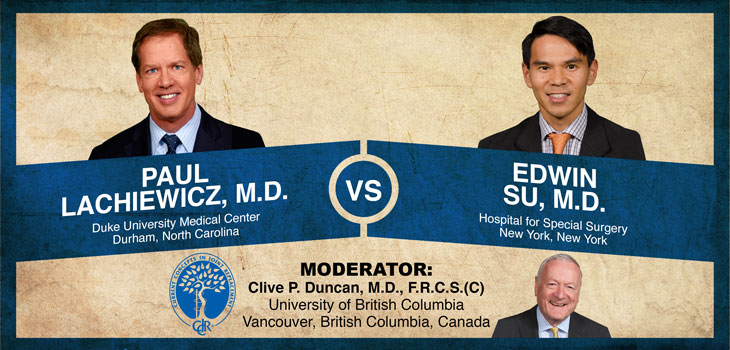
This week’s Orthopaedic Crossfire® debate is “Dual Mobility in Primary THA: Yet to be Justified.” For the proposition is Paul Lachiewicz, M.D. from Duke University Medical Center in Durham, North Carolina. Edwin Su, M.D. of Hospital for Special Surgery in New York is in opposition. Moderating is Clive P. Duncan, M.D., F.R.C.S.(C) of the University of British Columbia.
Dr. Lachiewicz: “Dual mobility components should not be routinely used in primary total hip arthroplasty (THA). The basic issue is, ‘What should we do to prevent dislocation in primary THA?’ You need correct acetabular placement (what is a ‘safe zone’ is debatable). You want to restore leg length and offset, and if you do a posterior approach, you want to repair the capsule.”
“The first dual mobility hip tried to combine the low friction of a Charnley with a 22mm head against a polyethylene, larger ball that articulated with stainless steel. The supposed biomechanics states, ‘There is greater range of motion (ROM) if you have two articulations.’ I will submit that there is a third articulation with contact between the neck and polyethylene. There is supposedly increased jump distance with a large polyethylene head, and there’s very little lab data—except from the manufacturers.”
“However, last year a 3D CT cadaver model came out, stating that there is no difference in ROM between the 36mm head and a dual mobility. The other interesting thing is that there is little lab data on wear. This is a new concept, namely, the inner polyethylene ball and the outer polyethylene surface.”
“I think there is a place for these in revision situations, especially for recurrent dislocation. What about in primary total hips? Yes, perhaps high risk patients such as those with fractures and neurological disorders.”
“The initial data on dual mobility came from Europe. In a study of nearly 400 hips with a high survival rate, an unusual and new complication reared its head—intraprosthetic dislocation. In this series it was only 14 hips, however, Moussa Hamadouche has a series of 168 hips with no dislocations. But at 5-7 years there were four intraprosthetic dislocations, presumably due to wear and impingement; all required revision.”
“There is recent data from the lab at Massachusetts General Hospital looking at whether there was iliopsoas impingement with dual mobility. In one patient the multiple wires are in a poly head, and the single wire (anteriorly) is in the psoas tendon. The radiograph supposedly shows impingement or pressure on the psoas tendon. Could this lead to persistent groin pain in patients who have dual mobility in primary situations?”
“At the closed meeting of the 2014 Hip Society gathering Peter Sharkey presented 100 modular dual mobility hips, most of which had 22mm metal heads. At only two years of follow up 13 patients had elevated cobalt levels, and 7 had elevated chromium levels.”
“They can still dislocate; there are those who dislocate the metal head from the polyethylene. You can’t eliminate all dislocations, but in our series we had no recurrence and no revisions. We looked at this at a minimum of five years, and found no late dislocations and no liner fractures. We’re looking at our 10 year results now and we have not seen anyone with trunionosis or component loosening. Osteolysis has been an issue with highly crosslinked polyethylene (XLPE), but as of now we don’t see any major difference with the smaller heads.”
“So I think dual mobility in primary THA is yet to be justified. Yes, there are theoretical advantages, and I use them for recurrent dislocation, but not for primary cases.”
Dr. Su: “The dual mobility principle was introduced in the 1970s and it combines Charnley’s principle of low friction arthroplasty with the McKee-Farrar theory of a large head. Both articulations can move, theoretically dividing the possibility of friction, wear and dislocation. And most mobility—at least in simulator studies—comes from the smaller inner bearing. I believe that dual mobility can impart an increased hip stability, provide excellent ROM, and reduce impingement (if you have a greater head/neck ratio).”
“Dislocation as a reason for hip revision is on the rise, probably because patients are younger and more active these days. Constrained liners have been proposed as a solution for dislocation, however most would agree that dual mobility is preferable to constrained liners because the latter have multiple interfaces that can fail.”
“My indications for a dual mobility hip in a primary setting are those patients who are at risk for dislocation. The current designs could be anatomic. In one such design it is sided for right and left; there is a cutout for the iliopsoas tendon in order to avoid soft tissue impingement. It has a large head size and the thickness of the cup is about 3mm, so there’s a 6mm differential between the head and the cup.”
“The inner head is large diameter and the inner head is constrained within this outer polyethylene head. The inner head could be ceramic or cobalt chrome; heads now are generally highly crosslinked polyethylene and the construct is assembled on the back table to ensure that the head isn’t going to come out of the polyethylene. Most of the movement is coming from the inner bearing and when it gets to the extremes then the movement comes from the outer bearing.”
“With the dual mobility shell the joint is more stable (large head) and you can put the cup more anatomically with respect to version. The disadvantages of dual mobility—with the solid one at least—is that you can’t visualize the acetabular floor, you can’t use screws with the anatomic version, you can have intraprosthetic dislocation, and there’s a question of increased wear because you have two interfaces.”
“We believe that a larger head would provide more stability because of a greater jump distance. A (manufacturer) study on wear in a simulator looked at the highly crosslinked outer bearing dual mobility liners—three different models. One of the groups was microseparation and the other was with third body particles; they found that the dual mobility construct did have a high tolerance for wear (although it was more increased in the microseparation group).”
“It’s not suggested that you put your cups in at 65 degrees, but if you do put them in at a higher elevation angle than intended, there is wear reduction compared to a metal-metal bearing. One study with 10 year follow-up showed no dislocations in over 200 dual mobility hips. One socket was revised for loosening at nine years, but the design was a macro texture ongrowth surface.”
“Another study involved 240 dual mobility hips with a mean follow-up of over 20 years; there were no dislocations of the outer bearing. However, they did find a 4% intraprosthetic dislocation rate and some revisions for socket revision because it was a smooth design. The stem used has a very large neck and it’s thought that the intraprosthetic dislocations were due to impingement of that thick neck against the poly liner. Dr. Sculco has done over 400 of these with two year follow-up and has not had any dislocations in the primary hip setting.”
Moderator Duncan: “Paul?”
Dr. Lachiewicz: “Tom Sculco and Ed are superb surgeons and they can do the non modular dual mobility shell successfully. But if there is any type of anatomic abnormality then you probably need a shell with screws. Then that leads to another articulation of titanium against cobalt-chrome. I’m very concerned about other possible mechanisms of failure that we haven’t even thought about.”
Dr. Su: “Paul makes a good point. The solid monoblock version would be safer as far as reducing the interfaces. That’s what we propose be used in the primary setting. It gives you the largest head size possible.”
Dr. Duncan: “Is one of the take home messages that you must avoid the use of a 22mm head?”
Dr. Su: “I’m not sure I would go that far. You are constrained by the cup size, so there are some cases where we’ve used the 22mm inner bearing. My point was that the design with the intraprosthetic dislocations to a high degree had a very large neck size. So the head/neck ratio was very poor.”
Dr. Duncan: “Paul, when you’re approaching the problem of a recurrent dislocator how do you decide between a constrained cup that will capture the head versus a dual mobility?”
Dr. Lachiewicz: “The indications are still evolving. I reserve constrained liners for very elderly patients, those with dementia, and late dislocations where you cannot find a reason for it. I’m using the dual mobility more in young patients, but that’s a moving target with regards to dislocations.”
Dr. Duncan: “Ten years ago young patients came to us with a large head metal-metal because they were obsessed with dislocation…they’re now coming to us for dual mobility because the information about low risk of dislocation has reached them. Anyone want to share an editorial on this?”
Dr. Lachiewicz: “I haven’t seen that yet. I generally would dissuade them because we don’t have long term follow-up in the U.S. on these designs.”
Dr. Su: “We are getting these requests. I agree with Paul…caution them because of a lack of long term data. I’d be concerned about using this in younger patients because of wear. Theoretically it would be better because of XLPE, but all of the studies done in the past were in older patients.”
Moderator Duncan: “Thank you, gentlemen.”
Please visit www.CCJR.com to register for the 2015 CCJR Spring Meeting, May 17 – 20 in Las Vegas.
React:
Discussion
This is a fascinating development. In my practice we've seen similar outcomes with the revised protocol. The key differentiator seems to be patient selection criteria. Has anyone else noticed the correlation with BMI thresholds?
Great point. I'd push back slightly on the conclusion, the sample size in the cited study is too small to draw population-level inferences. That said, the directional signal is compelling and worth a larger RCT.
We implemented a similar approach last year. Early results are promising but we're still gathering 12-month follow-up data. Happy to share our protocol if anyone is interested.
Join the conversation
Orthopedic professionals are discussing this. Sign in and upgrade to read every comment and add your voice.